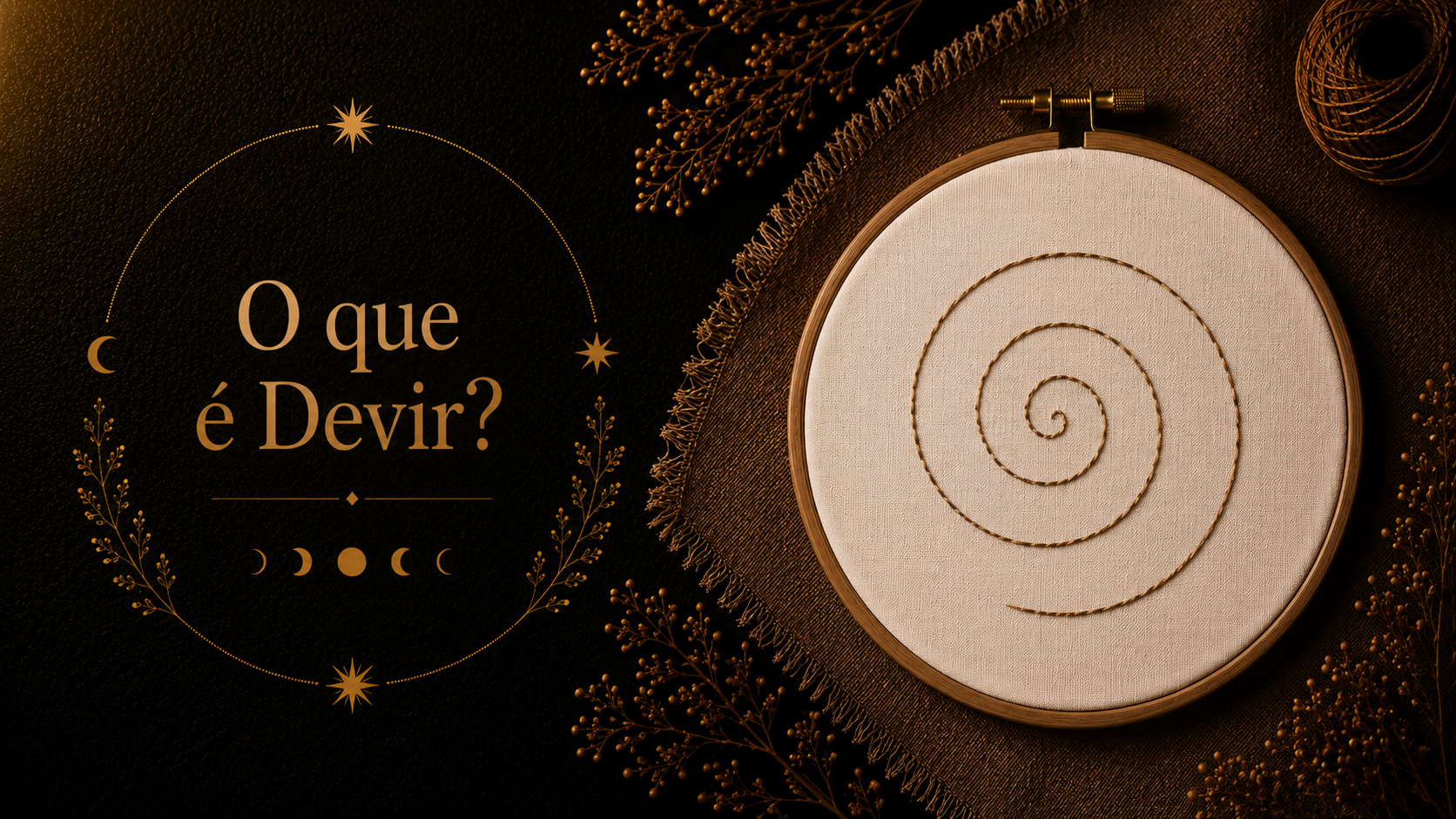
Devenir is a word describing a concept coined by the French philosopher Gilles Deleuze to characterize a way of thinking about processes of change. It indicates a process of transformation. For me, it is a very succinct way of describing my life. In English, the chosen term is “becoming.”
Now, as a true Scorpio, I was already born with that extra understanding about the processes of transformation that every human being goes through throughout life, but I confess that when I heard “becoming,” many loose threads in my mind became intertwined.
The first time I heard the term was in a talk by Gimena Romero, during an Instagram Live from Clube do Bordado. Romero holds a degree in Fine and Visual Arts from La Esmeralda and, since 2008, has dedicated herself to embroidery as an artistic expression. She has published several books, such as “México bordado: De la tradición al punto contemporáneo.”
But the fact is that Romero’s words moved me deeply, and still move me to this day, when she said:
“We embroider today because embroidery holds so much life, and life escapes us every day, every minute, in every rush. It demands attention, so much presence, that it forces us to see the life that is happening right now. Now, in these days, in this time, we are not here merely to transmit technique, but rather to share the gaze of embroidery, the becoming of embroidery, the incarnation of embroidery that lives in every embroiderer.”
I understand the Becoming Embroidery as a process of individual transformation through the act of embroidering. You lean on something material and tangible to express what cannot be put into words, and often this process can foster a feeling of reconnection with oneself.
While we embroider, the process of concentration, focus, and dedication to each stitch keeps us in the present moment, whether in a conversation within a support network with other embroiderers or in the silence of our own thoughts. In my experience, and in dialogue with research on manual processes, I perceive that the act of embroidering allows you to reintegrate yourself, process your thoughts, and find within yourself the answers you always seek outside for internal problems, because it is only in silence that we learn to listen. This is a process of rebirth.
Beyond the individual, embroidery also relates to the world and to history. For many centuries, it served as a means of indoctrinating women; it was even used as a school discipline.
The historian Rozsika Parker discusses how many forms of female production remained invisible or confined to the domestic sphere, and many of these arts were lost.
Embroidery emerges in many important periods of great human transformation. During World War I, soldiers used embroidery as occupational therapy in motor recovery processes. For Zuzu Angel, during the Brazilian dictatorship, it was a way to denounce the death of her son and the violence of the regime. During World War II, it was seen as an act of espionage, as hidden messages were shared through embroidery, the most famous of which is the Changi Quilt.
All these historical movements carry individual transformations that materialize into tangible art through thread and needle on fabric.
So I ask you: what process do you need to embroider today in order to transform yourself as well?
- CINTRA, Fernanda do Nascimento; MESQUITA, Cristiane Ferreira. Design, embroidery and resistance: between Zuzu Angel and Linhas de Sampa. DAPesquisa, Florianópolis, v. 16, p. 01–26, 2021. (Suggested reading here)
- GIL, Maria Celina. Swords and needles: relations between embroidery and war. dObra[s] – revista da Associação Brasileira de Estudos de Pesquisas em Moda, [S. l.], v. 18, n. 45, p. 70–90, 2025. (Suggested reading here)
- PADILHA, Tita. Invisible wefts: the complex weaving of the feminine being as an embroidering artist. In: Fórum Bienal De Pesquisa Em Artes, 8., 2017, Belém. Anais […]. Belém: PPGARTES/ICA/UFPA, 2017. (Suggested reading here)
- PARKER, Rozsika. The subversive stitch: embroidery and the making of the feminine. London: I.B. Tauris, 2010. (Suggested book here)
- Clube do Bordado Instagram Profile (Here)
- Gimena Romero Instagram Profile (Here)
- ROMERO, Gimena. México bordado: de la tradición al punto contemporáneo. Barcelona: Editorial Gustavo Gili, 2017. (Suggested book here)
Leave a Reply