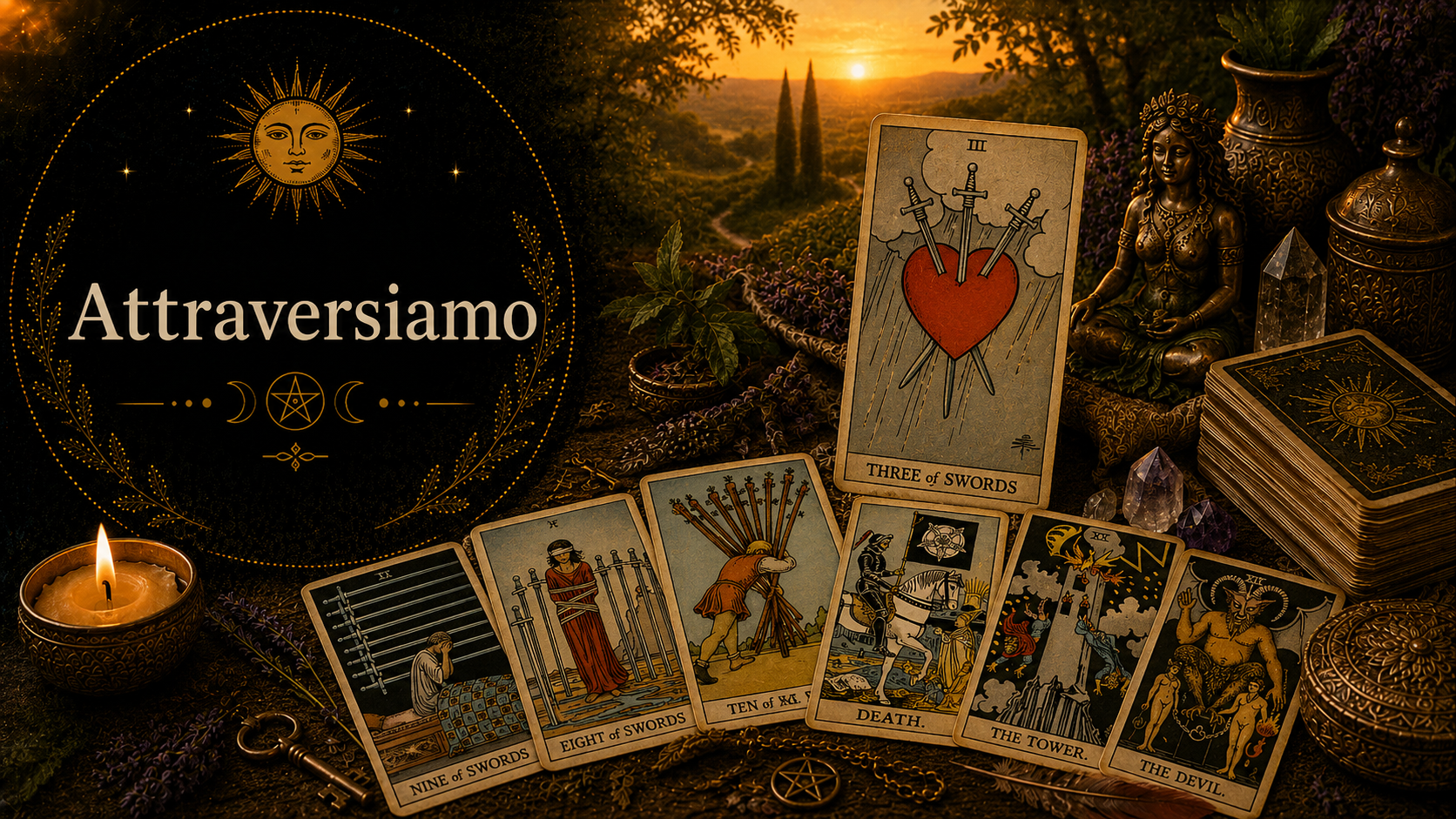
The other day I had a tarot reading. The question was about matters of the heart. And, for the second time, the Three of Swords appeared.
The famous “broken heart” card.
My first reaction was to negotiate.
“But do I really have to go through this?” “Isn’t there an alternative path?”
The answer came almost like a scolding:
“You are repeating a pattern. You need to cross it to end it. Avoiding it is also a way of staying in it.”
I found that curious.
If I moved forward, it hurt. If I ran away, it also hurt. That was when I realized something. Life doesn’t always ask us if we want to go through a certain experience. Sometimes it just answers: let’s cross.
Those who follow this blog have already noticed that I like to look at the tarot less as an oracle that predicts the future and more as a great symbolic mirror.
The cards do not create our fears. They only give them an image.
And some images are truly frightening. For a long time, for example, I had real dread of the Nine of Swords.
It is the card of sleepless nights, of anxiety, of the mind that convinces you that everything is about to collapse. I look at it with considerable respect.
For a few years, anxiety attacks made me believe I was having a heart attack. I went to the hospital in the middle of the night more times than I would like to admit.
Today I understand that my body was not announcing the end of my life. It was asking for the end of a pattern. I had to cross through that to learn how to take care of myself.
There is also the Ten of Swords, which usually represents the closing of a painful cycle. It is an intense card. But it brings an important detail: it is a ten.
That is, no matter how bad it seems, that story ends right there.
Even Death, one of the most feared cards in the tarot, has never scared me that much. Quite the opposite. It has always reminded me that some versions of ourselves need to end so that others can be born.
Perhaps that is what I like most about the tarot. It does not promise a life without suffering. Nor does it say that everything will work out. It just reminds us that no card remains open forever. Every card is part of a sequence. Every night ends. Every season changes. Every wheel keeps turning.
I went home thinking that perhaps the problem was never the Three of Swords.
The problem was my desire to find a path that would allow me to grow without feeling pain. But that path, at least so far, I have not yet found.
So I keep learning. One Italian word I like to carry with me:
attraversiamo. Let’s cross.
Because some landscapes of life only exist on the other side of what we had the courage to cross.
The RWS (Rider-Waite-Smith) tarô was used, created by Arthur Edward Waite in 1909 and illustrated by Pamela Colman Smith. It is popularly known for being the most widely used card deck for begginers.
Leave a Reply