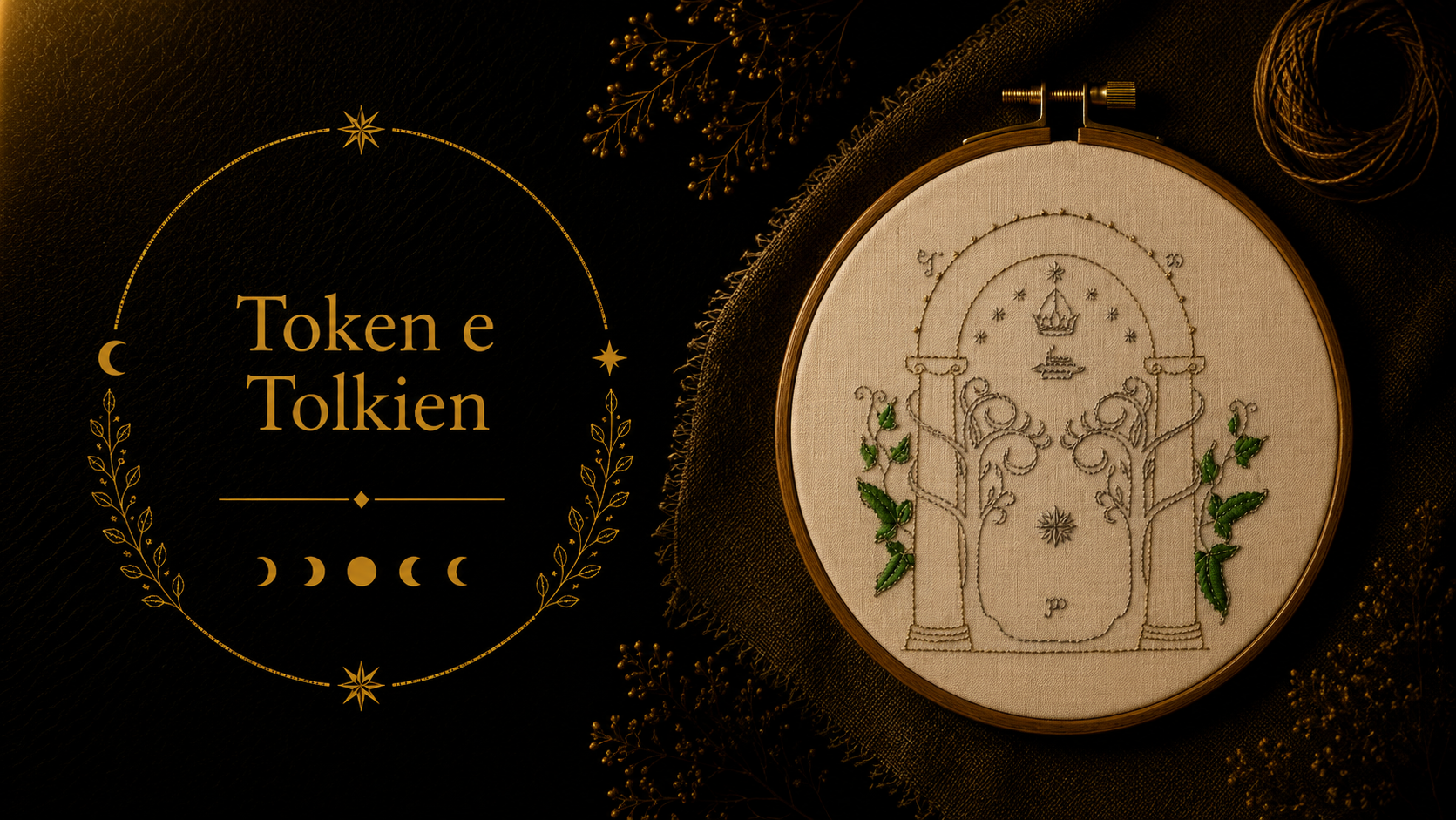
The other day I went to approve blog comments. In the middle of the messages, two curious comments appeared:
knwqmtkwzhyeesvrwvgfueqojtpruv
mjhxlkketykipjjuhllffxvxvrivqdo
It wasn’t Portuguese. It wasn’t English. It also wasn’t Sindarin.
For a few seconds, I thought some elf had tried to get in touch. Then I imagined an orc had tripped over the keyboard. The funniest hypothesis didn’t last long. They were just bots.
Automated programs that roam the internet trying to post spam on unprotected forms. I confess I was a little disappointed.
But it was precisely this small digital invasion that led me to think about a curious word: token.
To protect the blog, I needed to configure Cloudflare, a system that identifies legitimate visitors and blocks automated access. An elegant captcha that is less annoying. Among other technologies, it uses tokens small temporary codes that function as proof of identity.
In computing, a token is exactly that: a sign that you are who you say you are. A permission. (It’s complex to explain, I’ll leave that mission to the developers, but I will index interesting research sources that helped me get here, at the end of the text, after the music—obviously!).
In fact, Gazola’s (2024) work shows this in practice: he created an application that allows GitHub users to “donate” their request limits, turning an access token into an act of collaboration, proving the complexity of the term.
But I found it curious because the word is much older than the internet.
It comes from the Old English tācen, meaning “sign,” “mark,” “evidence.” An object, a gesture, or a word capable of confirming something.
And it was impossible not to think of Tolkien.
John Ronald Reuel Tolkien was not just the author of The Lord of the Rings. He was a professor of philology at Oxford, a scholar of the history of words, and passionate about languages. Even before creating Middle-earth, he was creating languages.
That was when the technical world and the magical world collided on my blog. After all, this year we are celebrating 25 years of The Lord of the Rings.
The Pope cited Tolkien in an encyclical.
Rosa de Saron released a new album where one of the song titles is Mordor!
The British Royal Mint issued a coin in honor of the franchise!
You thought I wasn’t going to use a Token to talk about Tolkien?
Of course I will on that linguistic stumble.
The Quenya and Sindarin languages were not invented just to sound beautiful. They have grammar, phonetics, historical evolution, and their own language families. Tolkien believed that a language needed to carry the memory of a people.
When Faramir says:
“But I will give you a token that what I say is true.”
he is not talking about computing. He is talking about a sign. A proof.
An object that confirms a truth. In Middle-earth, almost everything works like this. The Ring is a token of power. The star of Eärendil is a token of hope. The leaf of Lórien is a token of friendship. The sword Narsil is a token of lineage and memory.
They are objects that say much more than they appear to.
I found it beautiful to realize that computing inherited exactly this idea.
A digital token also has no value in itself. It is valuable because it represents something. It represents trust. It represents authorization. It represents identity.
In the end, those incomprehensible comments taught me a small lesson.
Bots also produce sequences of letters. Tolkien also produced sequences of letters.
The difference is that some carry meaning, memory, and intention. The others just try to get through a form.
After installing the protection, the strange comments started going straight to the spam folder.
And the blog returned to being a place where words can do what they were born to do: create meaning.
Author’s note: While writing this text, I listened repeatedly to the song Mordor, by the band Rosa de Saron. According to Bruno Faglioni, the song uses Frodo’s journey to Mount Doom as a metaphor for the weight each person carries when facing their own shadows. I found it a beautiful companion to this reflection on language, symbols, and humanity.
- ARANTES, Luciana; SOPENA, Julien. Ensuring Token Circulation and Uniqueness in Algorithms with Nodes Organized in a Ring Subject to Failures. In: WORKSHOP DE TESTES E TOLERÂNCIA A FALHAS (WTF), 11., 2010, Gramado/RS. Anais […]. Porto Alegre: Sociedade Brasileira de Computação, 2010. (Suggested reading here)
- USER AUTHENTICATION VIA TOKEN. ANAIS DO EGRAD, [S. l.], v. 3, n. 6, 2016. (Suggested reading here)
- FRUGERI, Nelson. Understand once and for all what tokens are in GenAI. Medium, Sept. 25, 2024. (Here)
- GAZOLA, João Vitor. GitHub Token Donation Data Collection Tool. 2024. Undergraduate Thesis (Bachelor’s in Computer Science) – Federal University of Mato Grosso do Sul, Campo Grande, 2024. (Suggested reading here)
Leave a Reply