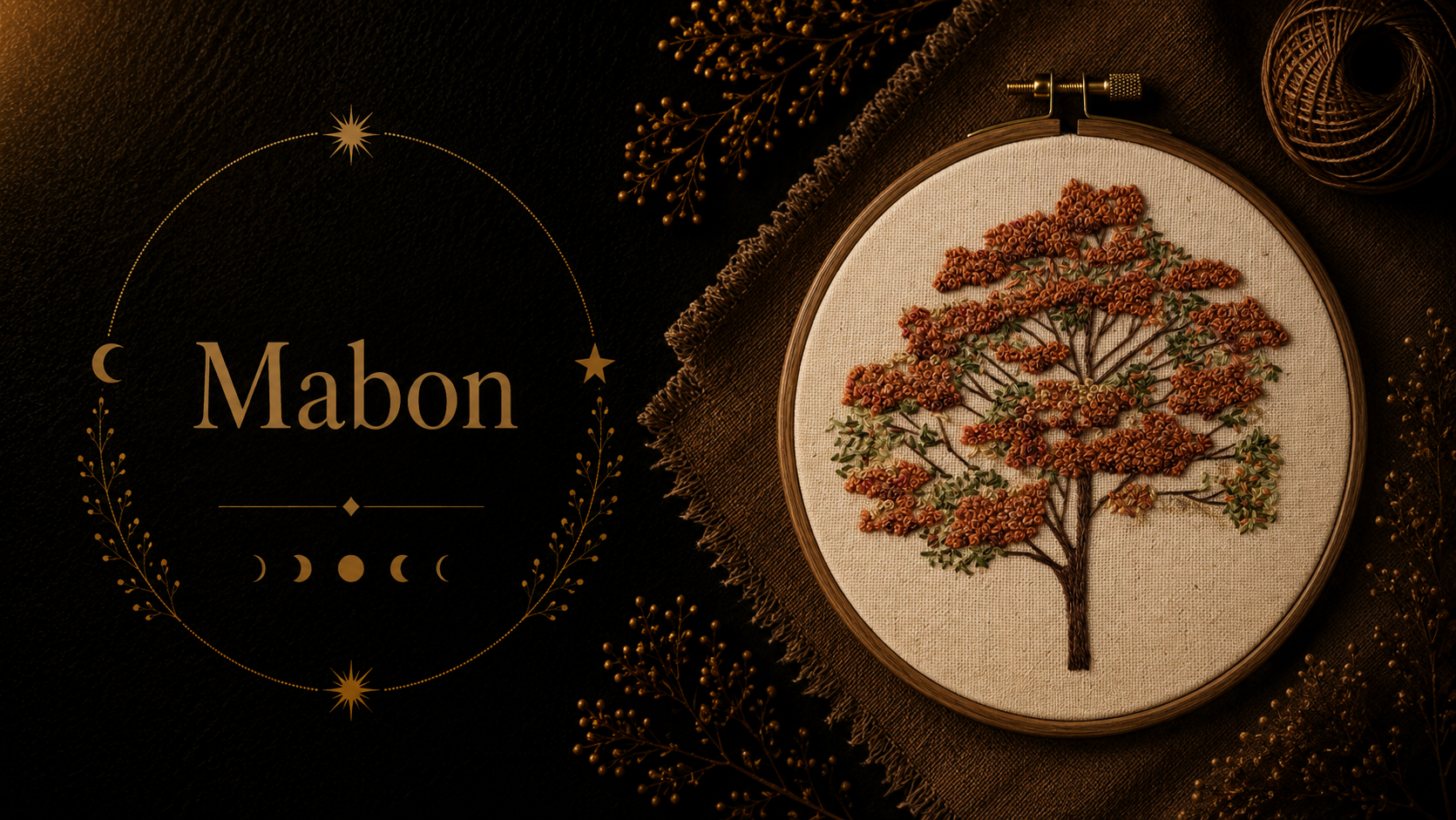
Autumn, like spring, is marked by an equinox. It is an astronomical phenomenon in which the Sun shines directly on the Equator, causing both hemispheres of the Earth to receive practically the same amount of light. The result is days and nights of very similar length.
It is when nature begins to slow down, leaves fall, the air cools, and the body itself seems to realize that it is time to slow down the pace.
Mabon is not merely a date on the pagan calendar it is a way of observing this moment in nature. For the Celtic peoples, it represented the second great harvest of the year, when grains, fruits, and tubers were stored to get through the colder months.
Mabon is a minor sabbat, which takes place in autumn.
Contrary to what many people imagine, its symbolism is not about making requests it is a time to give thanks and to look back, recognizing everything that was cultivated and harvested throughout the cycle that is ending.
Nature offers a beautiful image of this process: trees let their leaves fall to save energy during winter. They are not losing something they are preparing to continue living.
The foods traditionally associated with Mabon are those abundant in late autumn: apples, pomegranates, grapes, pumpkins, potatoes, carrots, onions, and grains such as corn, wheat, oats, and barley. It is a season that invites us to prepare breads, cakes, hot drinks, and shared meals.
The Celts maintained a very close relationship with the cycles of the earth because they depended on them to survive. Today, living in cities with supermarkets stocked all year round, it is easy to lose that perception of the seasons. Mabon invites us precisely to recover it by slowing down, observing, and understanding that resting is also part of the cycle of life.
And in Brazil?
In the Southern Hemisphere, Mabon takes place around March 20 or 21, when autumn begins. Nights gradually become longer, temperatures begin to drop in many regions, and various harvests mark the season, such as corn, pumpkins, apples, and, in the South, pinhão (Brazilian pine nuts).
Brazilian Indigenous peoples also have their own calendars, organized by the cycles of nature. Each people observes phenomena such as the flowering of trees, animal behavior, the phases of the Moon, or the rainfall patterns to guide their planting, harvesting, and celebration periods. Although these traditions have no historical connection to Mabon, they share a similar idea, giving thanks to the earth for what it offers.
Celebrating Mabon in Brazil can be, precisely, recognizing autumn through the landscape and traditions that belong to the place where we live.
My strongest memory of this season always involves apples.
When the temperature began to drop, it was almost automatic to prepare an apple-cinnamon tea. It was also the time for fresh corn cakes, made with still-fresh corn. I never liked coffee, though I love the smell of it being brewed through a cloth filter but tea was always my way of keeping up with the changing season.
Perhaps that is why, to this day, just feeling that aroma is enough for me to notice that the year has begun to slow down.
And remember: among the Celts, Mabon was also known as Alban Elued, an expression traditionally translated as “Light of the Waters.” The name refers to the balance between light and darkness that marks the autumn equinox and remains one of the poetic ways of remembering this passage of the seasons.
- Cook, F. (2024). The wheel of the year: An illustrated guide to nature’s rhythms. Andrews McMeel Publishing. (Book suggestion here)
- Davies, A. (2023). The mystical year: Folklore, magic and nature. Quadrille Publishing. (Book suggestion here)
- Kiernan, C. (2019). A little bit of Wicca: An introduction to witchcraft. Sterling Ethos. (Book suggestion here)
- Mankey, J. (2025). Year of the witch: A planner and daybook for everyday magic. Llewellyn Publications. (Book suggestion here)
Leave a Reply