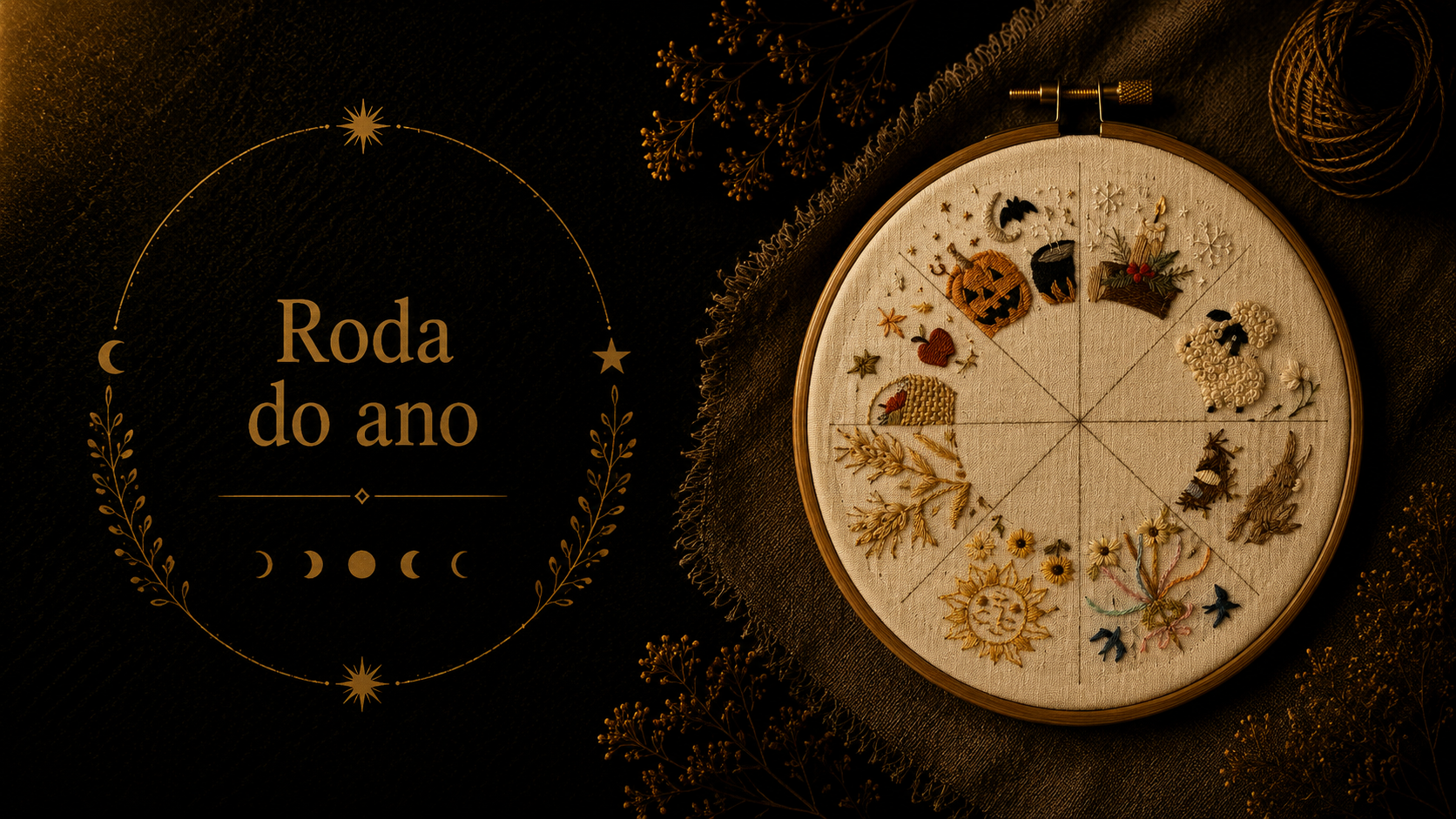
For a long time, I wanted to write this text.
The ideas would linger around my thoughts, but some more urgent matter always came up. Then, at bedtime, they would return. As if there are things that only rest when they finally find a place on paper or, in this case, on the screen.
In recent years, I came to know the Wheel of the Year, a ritual calendar present in traditions of Celtic origin that organizes time based on the changing seasons and the cycles of nature.
Although it emerged in a historical and cultural context very different from Brazil, something about this way of looking at time felt surprisingly familiar to me.
Not because I grew up knowing these celebrations, but because I grew up living many of the rhythms they seek to observe.
I was born in a city whose life was always deeply connected to the land and to coffee. There, the calendar was not marked only by dates it was marked by planting time, by harvest time, by the rains, by the dry spells, and by the changes in the landscape.
Many things simply appeared at the right time: lemons, cassava, yams, pumpkins.
And much of what circulated among people didn’t even pass through the market.
It was common for someone to harvest more lettuce than they needed and trade it with a neighbor for a few ears of corn, for fruit, or for another seasonal food.
Today I recognize this custom as a form of barter, but back then, it was just the way life happened.
That is why I still find it strange to have to buy certain fruits.
I love ponkan—I will write a text about it someday and I get indignant that I have to buy it at the market.
When I approached the Wheel of the Year, I didn’t feel like I was adopting a foreign tradition. What I found was a language capable of naming experiences that were already part of my memory.
I realized that time doesn’t always need to be understood as a straight line the cycles of the Moon return, the seasons return, and the harvests return.
Even we ourselves go through phases that seem to come back, though never exactly the same way. It is precisely there that becoming reappears.
Cycles do not repeat the past; they transform us with each return.
That is why these celebrations began to make sense to me. Not as an attempt to reproduce customs from another culture, but as an invitation to observe, more attentively, the relationship between time, nature, and memory.
Over the next few texts, I want to share a little of this path.
We will talk about the sabbats, the esbats, and other celebrations linked to the cycles of nature. But we will also talk about the memories these dates awaken in me, about life in the countryside, about plants, harvests, seasons, and the small experiences that shaped the way I learned to perceive the passage of time.
Because, in the end, the Wheel of the Year is not, for me, an attempt to be Celtic. It is a reminder that we are also part of nature.
And perhaps the earth has never stopped teaching us its cycles.
We are the ones who, sometimes, stopped listening to it.
- Cook, F. (2024). The wheel of the year: An illustrated guide to nature’s rhythms. Andrews McMeel Publishing. (Book suggestion here)
Leave a Reply