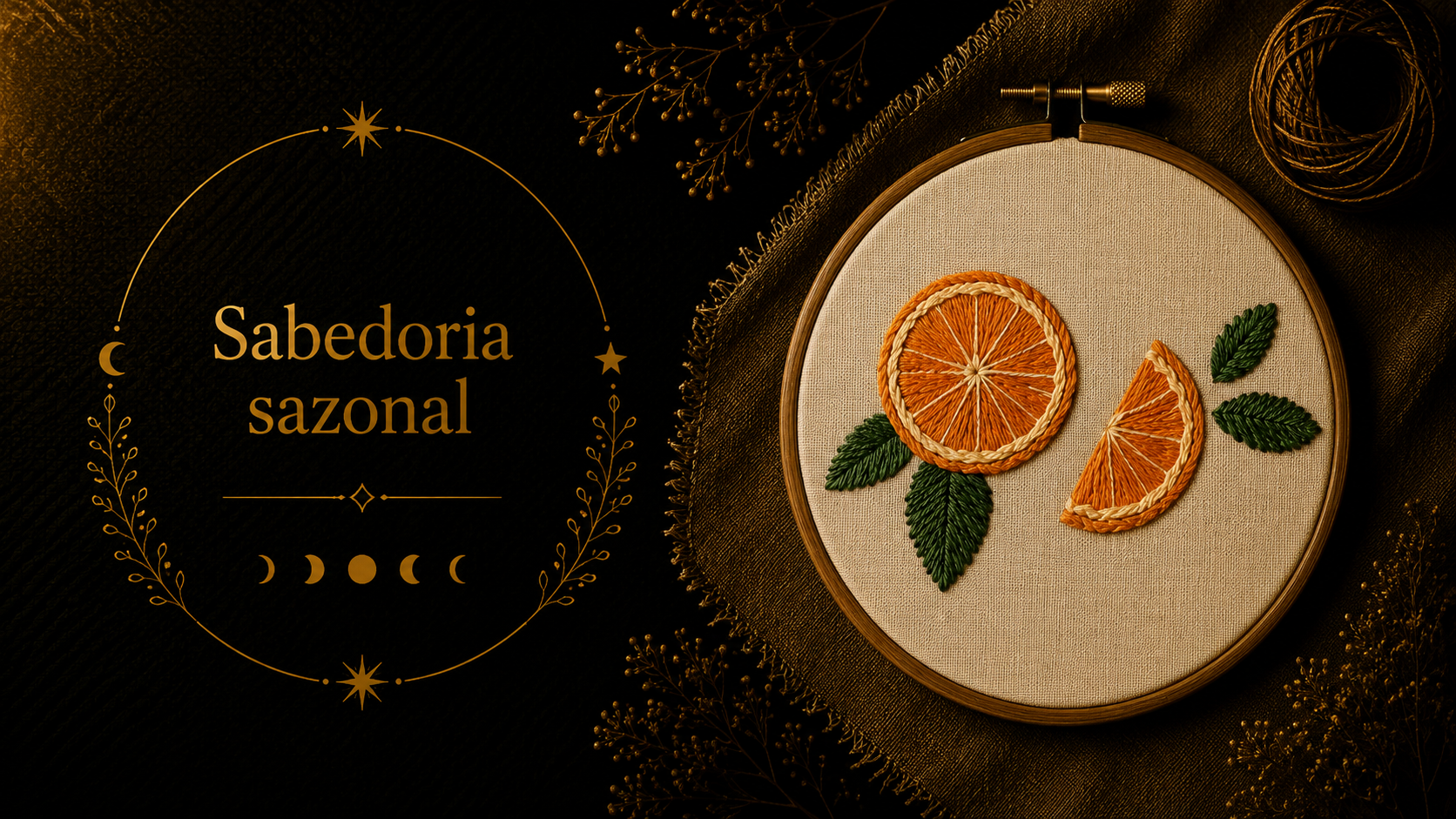
If you follow the texts here, you’ll remember me expressing my feelings about the ponkan.
Every time I go to the market and see a ponkan for sale, I feel a small pang in my chest it’s not exactly longing.
It’s the strangeness of having to buy a fruit that, during my childhood, simply appeared in the backyard when the right time came.
Today I want to talk about something that nature has been doing for thousands of years and that we have almost stopped noticing: seasonality.
The ponkan begins to ripen during autumn and reaches its peak in winter. Then it disappears not because someone decided to take it off the shelves, but because this is its time.
And it makes sense.
Citrus fruits are rich in vitamin C and other compounds important for the body precisely at a time when respiratory infections tend to increase. For a long time, before refrigeration and global food transport, this was what people had available.
Foods followed the seasons not only here.
In British tradition, for example, it is common to associate Christmas with oranges. During the 19th century, many children received a single orange as a Christmas gift and it was a precious food, difficult to obtain, and a symbol of abundance.
During World War II, when citrus fruits became scarce, this custom gained even more meaning. In the Northern Hemisphere, Christmas takes place in winter; here, our winter companion is the ponkan.
Not because one fruit replaces the other, but because each territory offers what it can produce at a given time of year.
When we observe this, we realize that our eating habits have always been deeply linked to the cycles of nature. Roots appear when we need more energizing foods.
Lighter fruits predominate in warm seasons. Tender leaves accompany the growing period. Diversity changes as the climate changes.
Today we find practically everything all year round.
This is an important achievement of agriculture, logistics, and food preservation. But it has also made many people forget that each food has its own time. Eating a fruit when it ripens is not just a matter of tradition.
It tends to be more flavorful, more abundant, and require fewer resources to reach us.
The ponkan reminds me of a childhood in which the seasons were perceived not by the calendar, but by what appeared in the backyard and the arrival of cold weather smelled of citrus fruit. And that said much more about winter than any weather forecast.
Nature continues to follow its cycles, but perhaps we have stopped observing them.
Next time you come across a ponkan at the market, try to remember that it is not just a fruit.
It is also an entire season ripening.
- Durbach N. One British Thing: A Bottle of Welfare Orange Juice, c. 1961–1971. Journal of British Studies. 2018;57(3):564-567. doi:10.1017/jbr.2018.84 (Suggested reading here)
- HERE’S Why You Get an Orange in Your Christmas Stocking. EatingWell, [S. l.], Mar. 6, 2026. (Here)
- SILVA, Aline Priscilla Gomes da et al. Índices de identidade e qualidade de tangerina ‘Ponkan’ produzida no estado da Paraíba. Agropecuária Técnica, Areia, v. 35, n. 1, p. 55-63, 2014. (Suggested reading here)
Leave a Reply