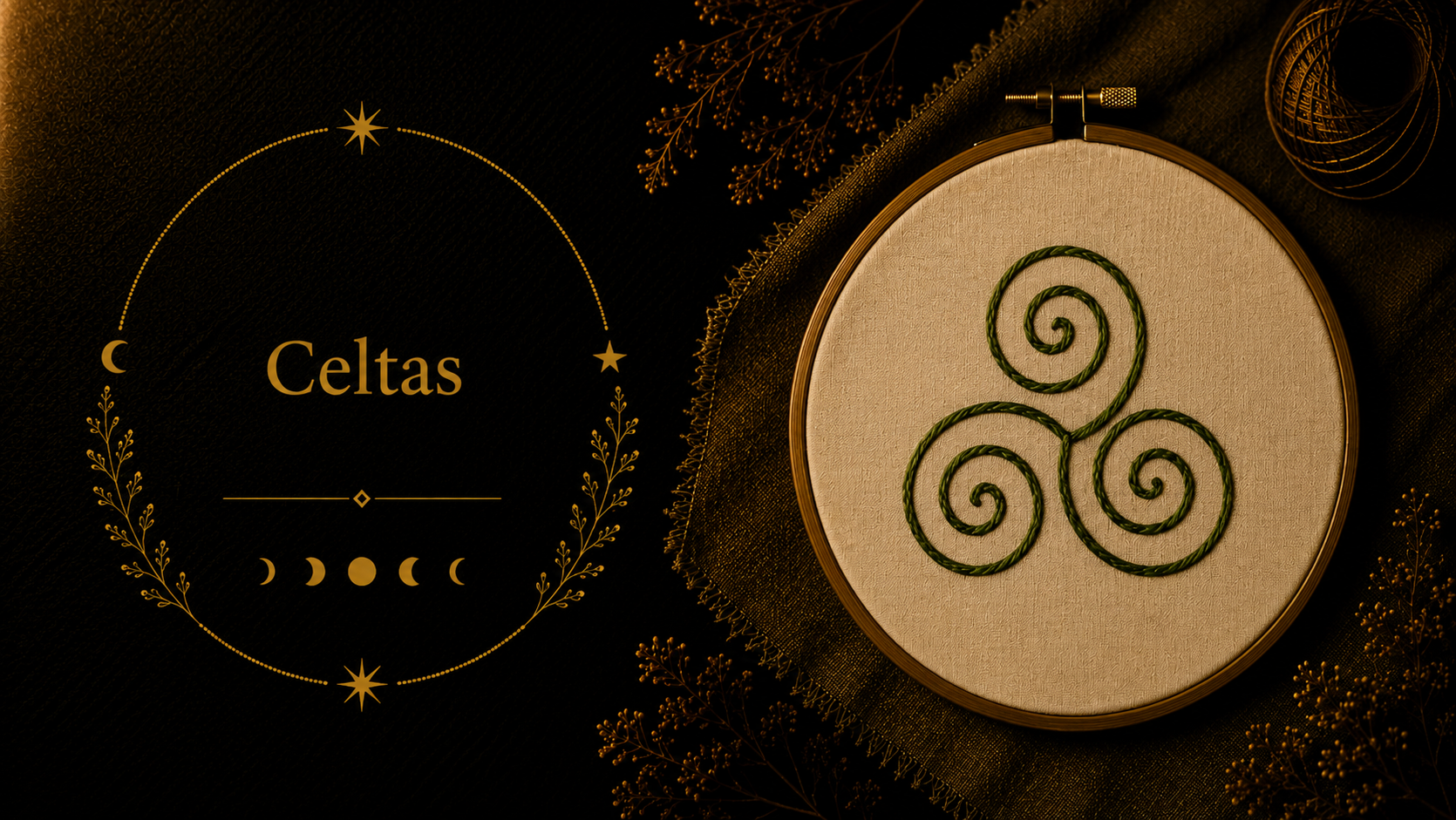
I have written quite a bit about the Celts on this blog. But I realized I never explained who these peoples were and why they appear so often here.
Egyptian culture is everywhere. Cinema, literature, documentaries, games, novels… Almost everyone has heard of the pyramids, Isis, Osiris, or Anubis. The Celts, on the other hand, remain much less known, despite the enormous influence they exerted on European history and imagination.
Perhaps that is precisely why I felt like writing this text.
Keeping in mind the historical differences between these contexts, there is a parallel that has always caught my attention. Just as many Indigenous peoples of the Americas, various Celtic peoples also underwent processes of conquest, cultural assimilation, and erasure of their traditions. In both cases, orality occupied a central place in the transmission of knowledge.
This was never a sign of backwardness quite the contrary, it was a way of preserving knowledge in people’s memory, not just in objects. For those trying to reconstruct this history centuries later, however, this represents a challenge: when few voices survive time, forgetting happens more easily.
The British poet and essayist Robert Graves, known for his interpretations of Celtic mythology in The White Goddess, comments that the tradition attributed to the druids deeply valued the oral transmission of knowledge. According to this perspective, writing down the most important teachings could weaken or distort their meaning. (We know this problem well: it’s called textual interpretation!)
The main reference used for this conversation is Claudio Blanc’s book, indicated in the sources at the end of the page. Some information is also complemented by other works and research, precisely because, for many centuries, almost everything known about the Celtic peoples had been recorded by their own conquerors.
It was only from the 19th century onward, with the advancement of archaeology, that new light began to be shed on this culture. Combined with oral traditions preserved mainly in Ireland, but also in Scotland, Wales, England, France, Portugal, and Galicia, these discoveries allowed us to understand a little better who these peoples were.
Celtic culture developed during the Iron Age, traditionally associated with two major archaeological periods: Hallstatt, located in present-day Austria, and La Tène, in present-day Switzerland. The latter archaeological site, in fact, became the main material reference for the study of Celtic civilization.
Celtic society was formed by different tribes that shared a common cultural matrix and a strong warrior tradition. However, contrary to what is often imagined, territorial conquest was not always the main objective of conflicts. Claudio Blanc draws an interesting parallel by observing that, in many aspects, Celtic wars resembled those practiced by various Indigenous peoples in Brazil—often motivated by local disputes, revenge, or plunder, rather than permanent territorial expansion.
Within this society, the druids constituted a distinct social class. They were advisors, judges, priests, and guardians of knowledge. There were different functions within the druidic tradition, but I want to highlight mainly their spiritual aspect, as it is the one that most dialogues with many of the texts published on this blog.
Curiously, one of the men who most contributed to preserving information about the Celts was precisely one of their greatest adversaries: Julius Caesar.
This creates a curious situation for historians: an important part of what we know about the Celts was recorded precisely by someone who was at war with them.
In The Gallic Wars, Caesar describes aspects of Celtic social organization and the role played by the druids. According to his accounts, they were not only priests but also philosophers, scholars of nature, advisors, judges, and those responsible for conducting religious rituals.
Although we know only part of the ancient Celtic deities, and although many of the names currently used for the sabbats were only adopted in modernity, it is possible to perceive that much of this imagery remained alive, especially through medieval Irish literature.
Julius Caesar himself mentions the existence of an important Celtic deity whom he identified with Mercury, following the Roman custom of associating foreign gods with the gods of their own pantheon. Mercury corresponds to the Greek Hermes and, centuries later, Hermes would be brought closer to the Egyptian god Thoth, giving rise to the figure of Hermes Trismegistus.
Just this sequence of encounters between different cultures would already yield an entire text.
Celtic life was deeply integrated with nature. Forests, rivers, mountains, springs, and lakes were not just elements of the landscape but spaces considered sacred. Some trees, such as the oak, received special veneration—it was believed, for example, that the mistletoe growing on its branches represented a manifestation of the tree’s very soul.
The relationship between the Celts and the sky was also very strong various megalithic monuments, such as henges, were used for astronomical observations and markings of solar cycles. Although Stonehenge was built many centuries before the emergence of Celtic culture, it ended up being incorporated into the modern imagination as one of the great symbols of this tradition.
There is also a rather curious aspect. For many Celtic peoples, the human head was considered the center of the soul and spiritual power it represented identity, consciousness, and the supernatural strength of the individual.
If you are an Umbanda practitioner, you might notice an interesting pattern here. In Umbanda, great care is given to the Ori, understood as the deepest dimension of individuality and consciousness the point of connection between the person and the divine.
I will write more calmly about this concept at another time, but I enjoy noticing how different cultures, separated by oceans and centuries of history, sometimes arrive at very similar questions about who we are and what our place in the world is.
Studying the Celts is not just looking at a people who lived over two thousand years ago. It is realizing how certain questions continue to cross humanity: Where do we come from? How do we relate to nature? What remains after a culture is conquered?
Despite colonization, transformations, and the silences imposed over the centuries, much of this knowledge remains alive. Sometimes preserved in medieval manuscripts. Sometimes in popular traditions. Sometimes just as a whisper.
But still alive.
Leave a Reply