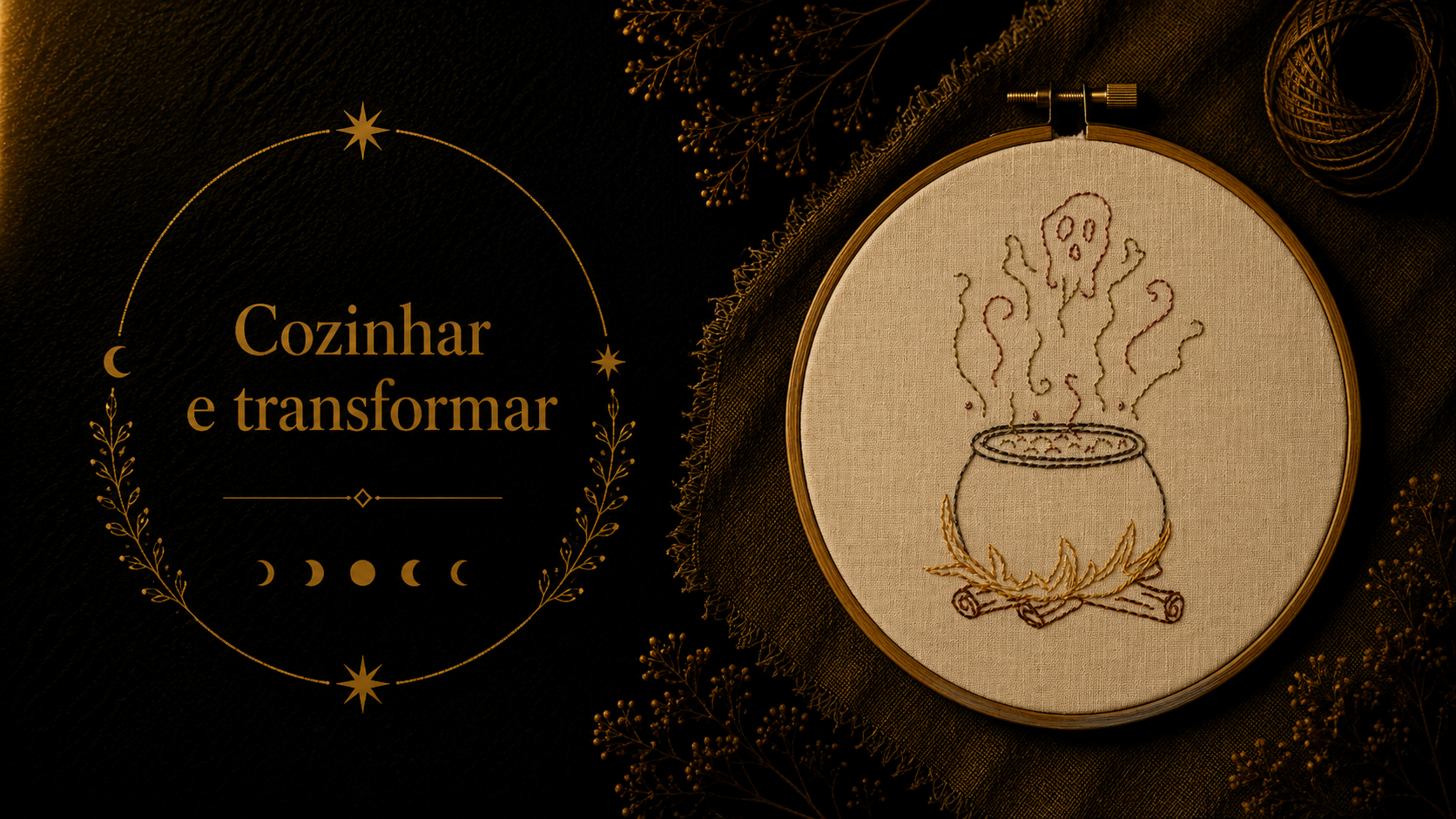
Before sharing any recipe here, I want to tell you something.
For a long time, the kitchen was the heart of the home.
Before electricity, piped gas, and modern stoves, fire occupied the center of the dwelling. It was what heated, illuminated, allowed food to be cooked, and gathered the family at the end of the day. Around it, stories were told, knowledge was transmitted, and daily life unfolded.
That is why cooking was never just a necessity it was always a way of transforming.
Transforming grains into bread, milk into cheese, fruits into preserves, herbs into teas, and simple ingredients into food, care, and memory.
It is not difficult to understand why so many traditions associated the kitchen with the sacred.
In European folk culture, for example, the figure of the house witch was not necessarily a fantastic character. She was, often, the woman who knew the times of the fire, of plants, of preserves, of home remedies, and of family nourishment. She mastered a body of knowledge passed down through generations.
Perhaps that is why, to this day, in any gathering, people end up meeting in the kitchen. There is something about that space that invites conversation.
While the food cooks, no one seems to be in such a hurry. And perhaps that is precisely the most important lesson.
Cooking demands presence.
The cake does not bake before its time, the dough needs to rest, the broth needs to reduce slowly, and there is no shortcut for certain transformations.
The kitchen forces us to respect rhythms.
This makes me think that every recipe is also a record of memory.
When someone teaches us a family dish, they are not merely transmitting a sequence of ingredients. They are transmitting gestures, preferences, ways of doing, and small stories that rarely appear in writing.
Each recipe holds a little of whoever prepared it before us.
Perhaps that is why a dish never tastes exactly the same when someone else makes it.
It is not only the technique that changes it is the experience of the one who cooks.
I like to think there is a small ritual in all of this not in the supernatural sense of the word, but as a gesture of attention.
Simple actions that make us slow down and notice where what we are about to eat came from.
In the end, cooking is also a way of giving thanks whether to the earth that produced the food, to the rain that allowed it to grow, or to the hands that planted, harvested, transported, and prepared everything until it reached our table.
So many important childhood memories have a smell. Even before becoming memory, they passed through the kitchen.
And that, for me, is already extraordinary.
Author’s note: This text was born during the reading of Arin Murphy-Hiscock’s The House Witch, but also from the memories of my mother’s corn cakes and the hot tea that kept me company while one of those insistent viruses decided to take up residence here.
- Murphy-Hiscock, A. (2017). The green witch: Your complete guide to the natural magic of herbs, flowers, essential oils, and more. Adams Media. (Book suggestion here)
- Murphy-Hiscock, A. (2018). The witch’s book of self-care: Magical ways to pamper, soothe, and care for your body and spirit. Adams Media. (Book suggestion here)
- Murphy-Hiscock, A. (2019). The house witch: Your complete guide to creating a magical space with rituals and spells for hearth and home. Adams Media. (Book suggestion here)
- Murphy-Hiscock, A. (2021). Der Garten der grünen Magie: Der zauberhafte Ratgeber für einen bezaubernden Hexengarten. Bassermann Verlag. (Book suggestion here)
Leave a Reply