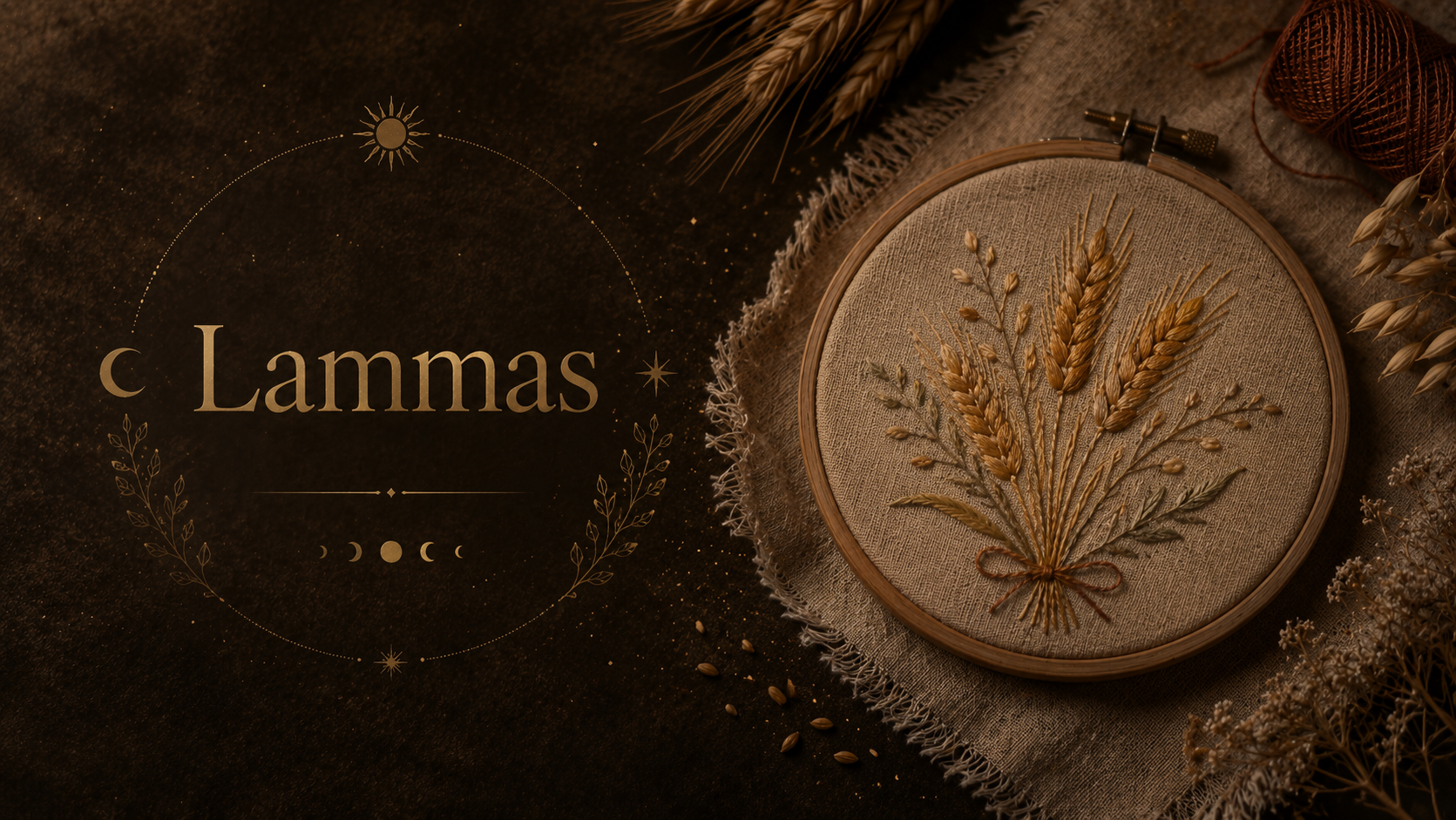
In the Southern Hemisphere, the beginning of February marks the celebration of Lammas, also known by the Celtic name Lughnasadh (pronounced loo-na-sah). It is the festival of the first harvest, one of the great sabbats of Celtic tradition.
The name Lammas derives from the Old English “loaf mass,” in reference to the medieval custom of preparing bread with the first flour of the harvest and taking it to be blessed.
Lughnasadh, in turn, honors the god Lugh and his foster mother, Tailtiu, who, according to Irish tradition, died after preparing the land for cultivation. Since then, the first harvest has also become a moment of gratitude for human labor and for nature’s generosity.
More than celebrating abundance, Lammas reminds us that no harvest happens by chance.
Before the bread, there was the seed and before abundance, there was waiting; but before the table, there was work. This perception of the earth’s cycles does not belong only to Celtic tradition.
Various Brazilian Indigenous peoples also organize their lives around the rhythms of nature. Among the Krahô, for example, the celebration of corn strengthens agricultural diversity and reaffirms the importance of collective production. In the Alto Rio Negro region, different peoples observe constellations to guide the appropriate time for planting and harvesting.
These are distinct traditions, but all recognize that cultivating food also means cultivating community.
And Lammas awakens in me a living childhood memory: every year, part of the family would gather at my aunt’s house to prepare the corn. And it was a true mutirão (collective effort).
The men would unload the sacks of corn, open the ears, and separate the husks. The women would grate, cut, and cook.
We, the children, would turn the husks into dolls while inventing games in the backyard because I was born in an analog era. At the end of the day, the kitchen felt like a small feast: there was pamonha (corn pudding), boiled corn, curau (corn cream), corn cake, fried corn fritters. Nothing from the harvest was wasted the leftover husks were set aside to dry and be used in the wood stove; leftover corn became feed for the chickens, and some corncobs were saved. At the time I didn’t know, to me it was just routine, just life happening, but today I realize that was also a celebration of the harvest.
I never learned the recipe for pamonha, and sometimes I wonder if anyone in the family still has it written down in some old notebook. But I believe the most important thing is not the recipe itself, but the way it was made: together.
Each person performing a part of the work so that, in the end, everyone would share the same food.
It is curious to notice how different cultures, even without any contact with one another, arrived at such similar gestures. I think the reason is that these experiences are deeply human.
Getting to know Indigenous peoples, studying the Celts, or learning about other ancestral traditions does not mean searching for a common origin for everything.
It means recognizing that different societies found their own ways of answering the same fundamental questions: how to care for the land, how to feed a community, and how to give thanks for the life that returns with each season.
- Cook, F. (2024). The wheel of the year: An illustrated guide to nature’s rhythms. Andrews McMeel Publishing. (Book suggestion here)
- Davies, A. (2023). The mystical year: Folklore, magic and nature. Quadrille Publishing. (Book suggestion here)
- Kiernan, C. (2019). A little bit of Wicca: An introduction to witchcraft. Sterling Ethos. (Book suggestion here)
- Mankey, J. (2025). Year of the witch: A planner and daybook for everyday magic. Llewellyn Publications. (Book suggestion here)
Leave a Reply