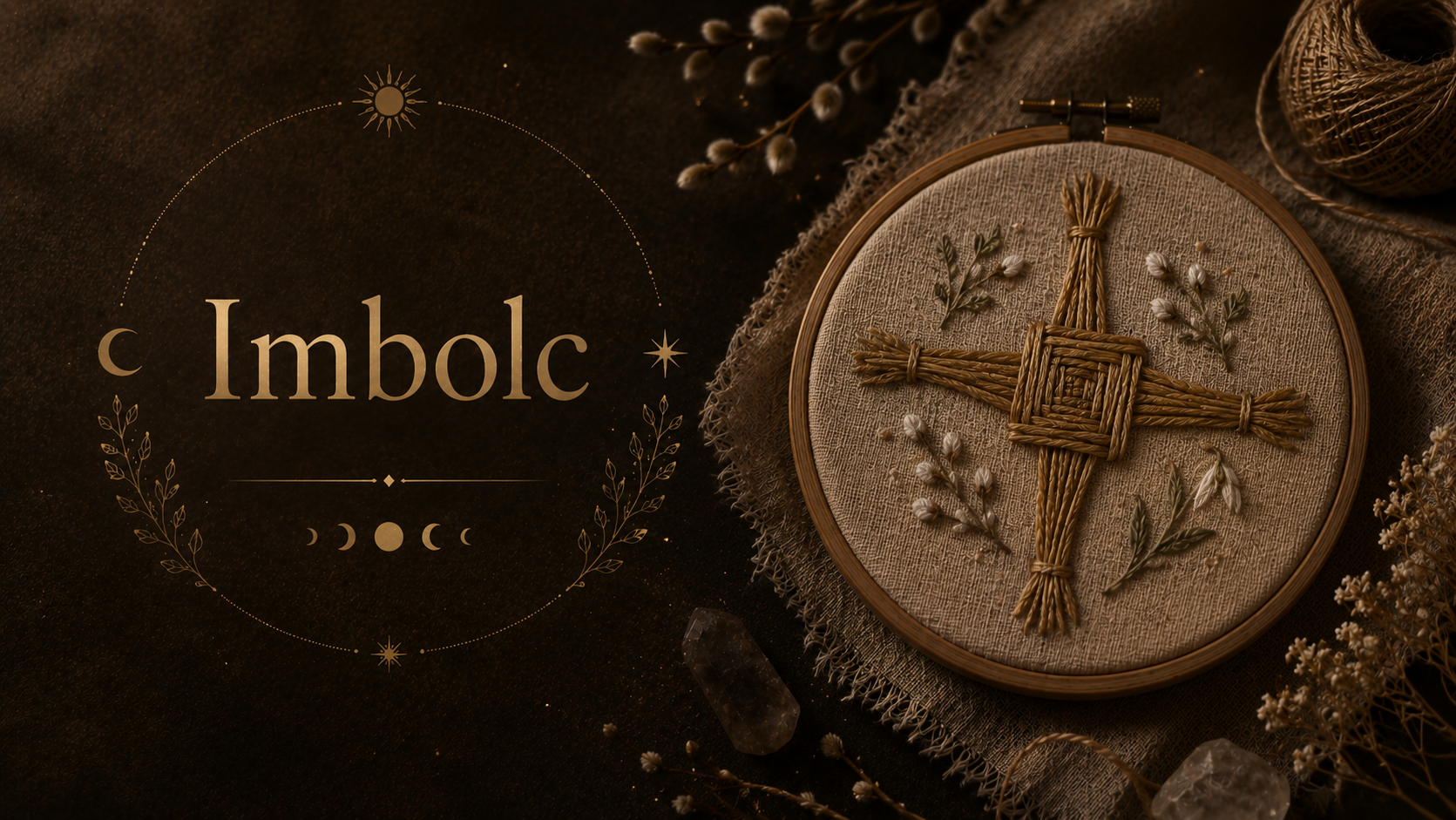
In the Southern Hemisphere, August 1 marks the celebration of Imbolc, one of the minor sabbats of Celtic tradition. Located between winter and spring, this festival announces that the earth, still silent, is slowly beginning to awaken.
Its name derives from the Gaelic i mbolg, “in the belly” a reference to the life that forms even before it appears on the surface. Another traditional name, Oimelc, relates to the first milk of sheep after winter, a sign that a new cycle is approaching.
Imbolc is dedicated to Brigid, a Celtic goddess associated with fire, poetry, healing, smithcraft, and fertility. For this reason, the celebration is often marked by the presence of lit candles, house cleaning, and the making of traditional Brigid’s Crosses, woven from straw or rushes and placed over doors and windows as a symbol of protection.
More than announcing the arrival of spring, Imbolc celebrates a nearly invisible transformation.
Nothing has bloomed yet, but life has already begun and this way of perceiving time has always caught my attention.
Although Celtic tradition belongs to Europe, many Brazilian Indigenous peoples also understand nature through its cycles. Among the Guarani Mbya, for example, there is the Ara Pyau, the “New Time” a period marked by spiritual renewal, community strengthening, and the reorganization of collective life.
It is not the same celebration.
Each people has its own cosmology, its own rites, and its own way of understanding the sacred.
What enchants me is realizing that such distant cultures arrived at the same intuition: that nature is never still. Even when everything seems motionless, something continues to happen beneath the surface.
Perhaps that is precisely why Imbolc awakens in me a childhood memory.
Until about the age of seven, my health was quite fragile. I went through several hospitalizations, many of them precisely during this period between the end of winter and the beginning of spring.
I remember my mother making Brigid’s Crosses for me.
At the entrance of the Santa Casa hospital in the city where I was born, there was a fan palm (Licuala grandis). Since there were no cell phones to distract a child during the long hours of waiting, I would play with the tree’s leaves. We would separate the finest fibers and, with them, weave small Brigid’s Crosses.
Traditionally, they are made with freshly cut rushes or straw. In that hospital, they were made with palm leaves.
The material changed, but the gesture remained.
With the Christianization of Celtic traditions, Brigid came to be associated with Saint Brigid, preserving part of her symbolism of protection and healing within the Christian imagination.
I cannot say whether it was Saint Brigid who healed me. Nor can I affirm that those small crosses had any supernatural power. What I know is that the memory of that care remained alive and perhaps that is precisely what symbols do.
They do not only change what happens around us; they also transform the way we remember what we have lived.
Today I realize that ancestry is not only about inheriting ancient traditions.
It is also in the small practices passed down within the home, in the stories told by our parents, in the gestures repeated almost without noticing, and in the affections that cross generations.
- Cook, F. (2024). The wheel of the year: An illustrated guide to nature’s rhythms. Andrews McMeel Publishing. (Book suggestion here)
- Davies, A. (2023). The mystical year: Folklore, magic and nature. Quadrille Publishing. (Book suggestion here)
- Kiernan, C. (2019). A little bit of Wicca: An introduction to witchcraft. Sterling Ethos. (Book suggestion here)
- Mankey, J. (2025). Year of the witch: A planner and daybook for everyday magic. Llewellyn Publications. (Book suggestion here)
Leave a Reply