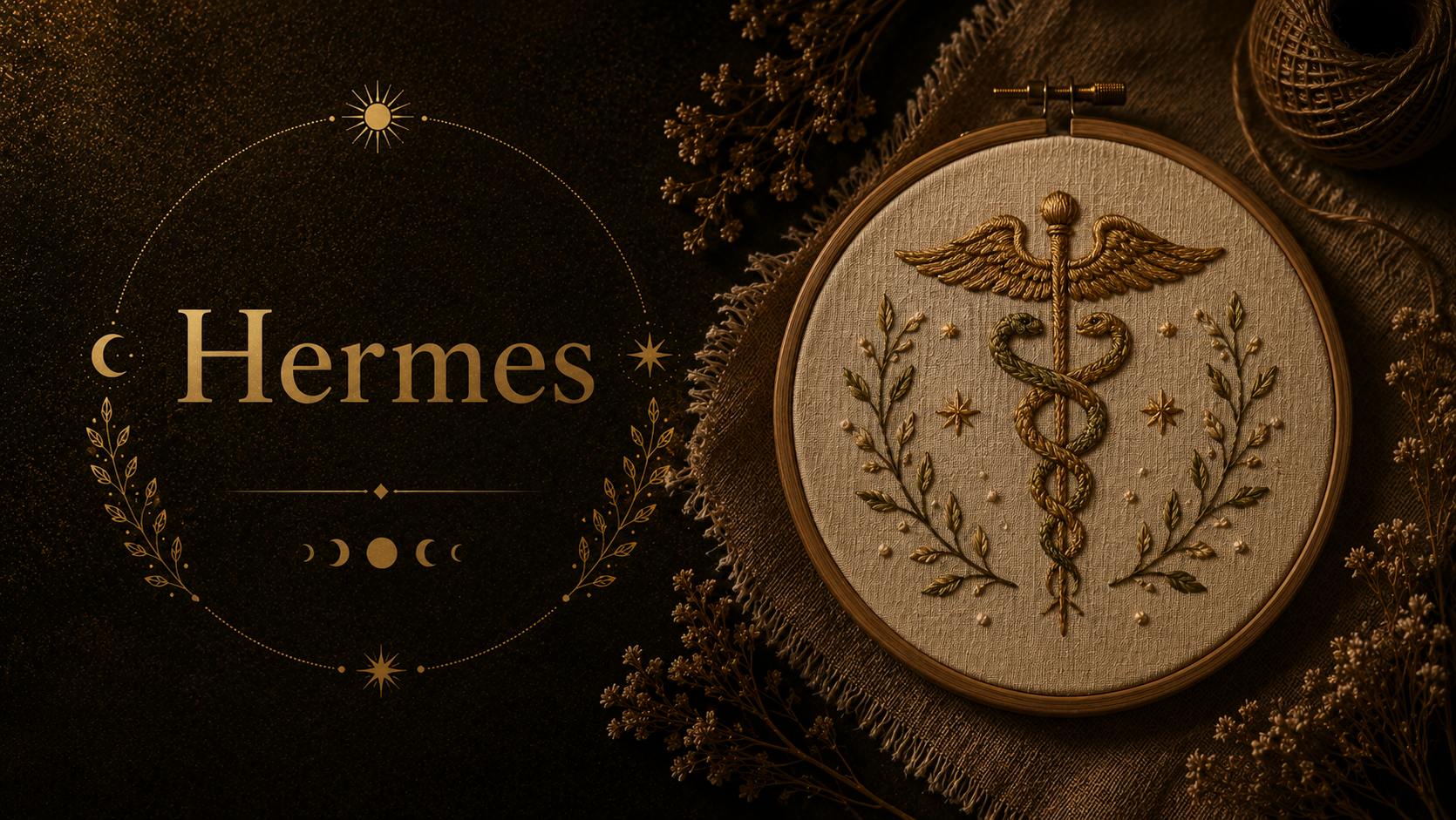
Throughout history, different peoples have imagined a figure capable of doing what few can: crossing boundaries.
Hermes, Mercury, Thoth, Turms, Nabu, Exu, different names and different cosmologies, yet all attribute great importance to characters who mediate paths, transport messages, translate languages, and bring distinct worlds closer together.
This is not to say they are the same deity, but to notice a symbolic recurrence that runs across cultures separated by oceans and centuries.
In Ancient Greece, Hermes is the messenger of the gods. Patron of travelers, merchants, interpreters, and those who live between borders, he moves easily between Olympus, the Earth, and the underworld. As a psychopomp, he conducts souls on their final journey. His caduceus, winged sandals, and petasus symbolize precisely this ability to transit between different planes of existence.
The Romans identified Hermes with Mercury, preserving many of his functions and expanding his presence in the daily life of the Empire.
In Hellenistic Egypt, Greeks and Egyptians brought together Hermes and Thoth, the Egyptian god of writing, wisdom, mathematics, and the measurement of time. From this approximation was born the figure of Hermes Trismegistus, “thrice-great,” a central figure in the Hermetic tradition, which would profoundly influence alchemy, astrology, and various philosophical currents of the West.
Among the Etruscans, we find Turms, another divine messenger often represented with wings and associated with the role of guide between worlds.
In ancient Mesopotamia, Nabu occupied a similar place as god of writing, wisdom, and prophecy he was considered patron of scribes and guardian of the records of destiny.
In Yoruba traditions and Afro-Brazilian religions, Exu occupies a singular place. Lord of paths, crossroads, and communication, it is he who circulates the word, opens and closes paths, and establishes mediation between the human world and the sacred. Although often compared to Hermes by scholars of comparative religion, Exu has his own cosmology, deeply rooted in African and Afro-Brazilian traditions.
What brings all these figures together?
Carl Jung’s analytical psychology offers one possible reading. From this perspective, such distinct characters could be understood as expressions of the same archetype; the messenger, the mediator, the one who establishes bridges between different realities.
It is not the only way to interpret this recurrence, but it is one of the best known.
Perhaps that explains why similar figures appear in such diverse historical contexts. Each society built its own myths, but many of them recognized the importance of the one who interprets signs, organizes knowledge, and allows a message to cross boundaries without losing its meaning.
It is an archetype that remains alive.
Perhaps it appears in the scribes of Antiquity, in medieval translators, in librarians, archivists, museologists, teachers, journalists, researchers, and contemporary artists. Each, in their own way, works to transport knowledge across different times, people, and languages.
The more I study memory and documentation, the more I realize that this crossing also happens in research because in all these gestures there is an attempt to make a message continue to traverse time.
Different peoples imagined different figures, but all seemed to recognize the same need: to have someone who could cross boundaries, translate languages, and circulate what cannot remain still.
Deep down, communicating has perhaps always been this: building bridges where there was once only distance.
- CÉSAR, Danillo. Hermes Trismegisto e a intenção do texto hermético. Classica – Revista Brasileira de Estudos Clássicos, [S. l.], v. 38, p. 1–20, 2026. (Suggested reading here)
- EFFGEN, André Luís Silva. Entre Thoth e Hermes Trismegisto: as cosmogonias egípcias na literatura hermética. 2023. 174 f. Dissertação (Mestrado em Ciências das Religiões) – Centro de Educação, Universidade Federal da Paraíba, João Pessoa, 2023. (Suggested reading here)
- VIEIRA, Thiago B. Hermes Trismegisto e o Corpus Hermeticum: um estudo sobre a relação do hermetismo com o pensamento filosófico renascentista. 2018. 33 f. Trabalho de Conclusão de Curso (Graduação em Filosofia) – Universidade Federal de Uberlândia, Uberlândia, 2018. (Suggested reading here)
Leave a Reply