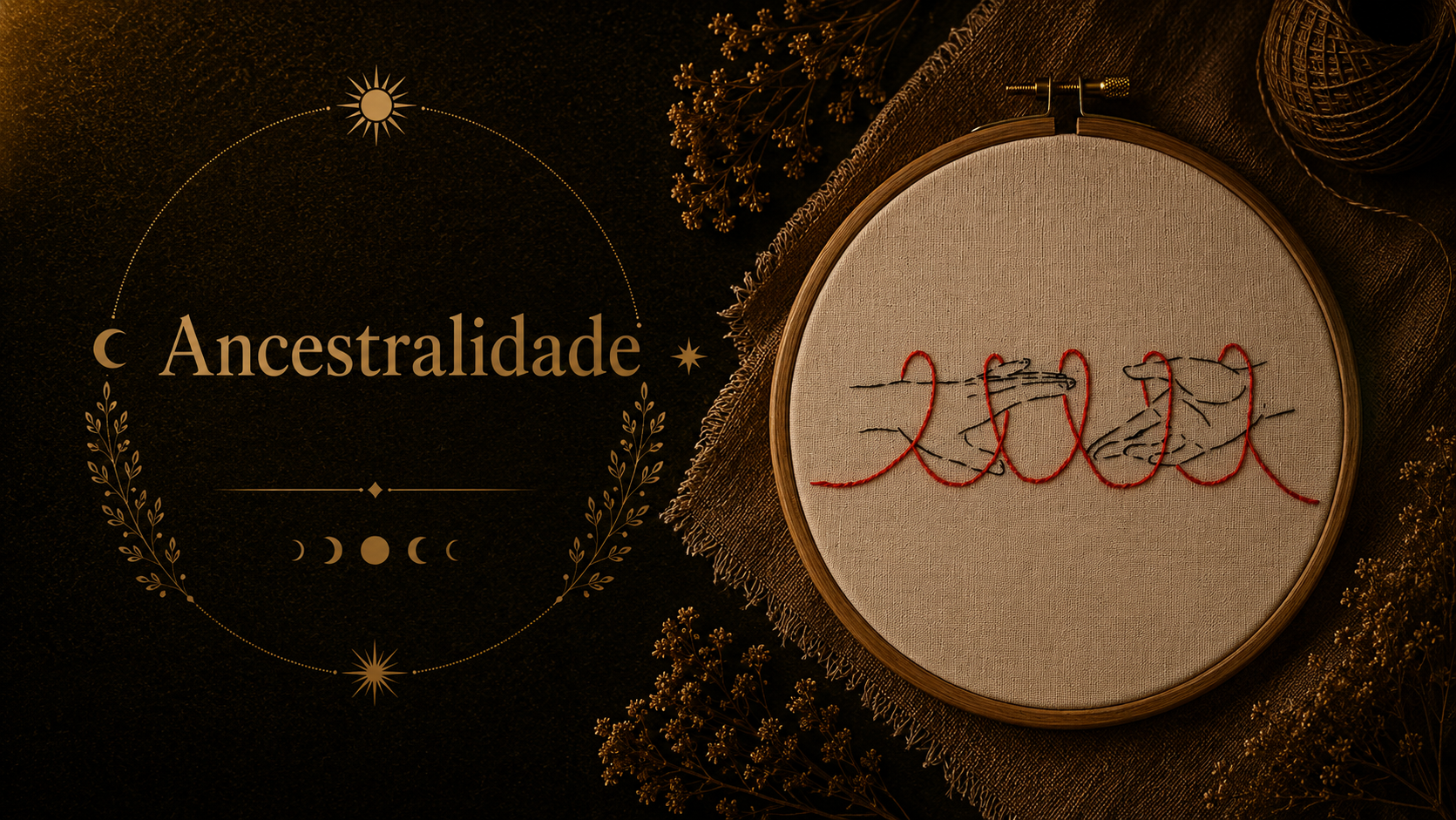
Whenever I write about Indigenous peoples, African cosmologies, or Celtic traditions, I imagine someone might think this is a blog about religion.
Actually, it isn’t.
Or rather: religion appears, but it is not the center of the conversation.
What interests me is understanding how different peoples organized their relationship with nature, with memory, with community, and with time. Beliefs are part of that story. Ignoring them would mean ignoring an important dimension of human experience.
When I speak of ancestry, I am not speaking only of spirituality.
I am speaking of the people who came before us.
Think about your own family. If your parents had made different choices, lived in another place, met other people, or gone through different circumstances, you probably would not be here in the way you exist today.
For each of us to be born, thousands of lives crossed paths over generations. Every decision, every encounter, every loss, and every new beginning helped build the path that led to us.
That is what I understand by ancestry.
In my family, this story passes through different cultural matrices.
On my mother’s side, there is a strong presence of the African diaspora. My great-grandfather was born enslaved. My grandfather grew up already free and was recognized in the community for his traditional healing knowledge and for the popular practices passed down between generations.
I do not see these stories merely as religious experiences. I see them as ways of preserving culture, identity, and dignity amid the violence produced by slavery and racism.
On my father’s side, the heritage is predominantly Portuguese.
But there is also another thread.
My great-grandmother was Indigenous. According to the story preserved by the family, she was captured with a lasso to be married. My grandfather used to say that she spoke little Portuguese—not out of inability, but because her first language was another. Learning the colonizer’s language was never a free choice.
These stories made me realize that ancestry is also made of encounters, conflicts, displacements, and resistances.
That is why today I am so interested in Indigenous cosmologies, in studies on the African diaspora, in African-derived religions, and in European traditions.
Not because I want to choose one of them as an identity. But because all of them help to understand who those people were and how they saw the world.
Religion appears in this path because it was part of the way these societies organized life. Just as today our beliefs, values, and ways of thinking also influence our choices.
Studying ancestry, for me, means investigating ordinary people. People who faced epidemics, migrations, wars, slavery, colonization, poverty, political changes, and environmental transformations.
People who worked, raised children, lost family members, cultivated food, developed techniques, told stories, and found ways to keep living.
Deep down, that is what brings me closer to anthropology. Understanding how different cultures responded to the same fundamental questions of human existence.
How to live in community?
How to deal with death?
How to preserve knowledge?
How to transmit memory?
How to care for the land that sustains life?
Perhaps that is precisely where the greatest teaching we can receive from those who came before us lies. Not to repeat their paths, but to understand their contexts. We are also building the story that one day will be remembered. The choices we make today will shape the world that other people will inherit.
Thinking about the climate crisis, the preservation of forests, the protection of cultural heritage, or the transmission of traditional knowledge is also thinking about ancestry—because ancestry is not only looking back. It is assuming responsibility for the future.
We are the result of thousands of choices made before us. And we are also making choices that, one day, will become memory for those who have not yet been born.
- DA SILVA GOMES, Francisca Cibele. DIÁSPORA AFRICANA: RESISTÊNCIA, SOBREVIVÊNCIA E RESSIGNIFICAÇÃO DOS SENTIDOS NO CATIVEIRO TROPICAL. Horizontes Históricos, [S. l.], v. 5, n. 2, p. 109–131, 2023. (Suggested reading here)
- SILVÉRIO, Valter Roberto et al. “Diáspora africana”: caminhando entre genealogias, abrindo novos horizontes / “African Diaspora”: walking between genealogies, opening new horizons. Contemporânea – Revista de Sociologia da UFSCar, [S. l.], v. 10, n. 3, p. 877-902, Sept./Dec. 2020. (Suggested reading here)
- XAVIER, Antônio Roberto; XAVIER, Lisimére Cordeiro do Vale. Colonização e formação da sociedade brasileira: causas, características e consequências. In: ENCONTRO CEARENSE DE HISTORIA DA EDUCAÇÃO (ECHE), 11.; ENCONTRO NACIONAL DO NÚCLEO DE HISTÓRIA E MEMÓRIA DA EDUCAÇÃO (ENHIME), 1., 2012, Fortaleza. Anais… Fortaleza: Imprece, 2012. p. 1839-1855. (Suggested reading here)
Leave a Reply