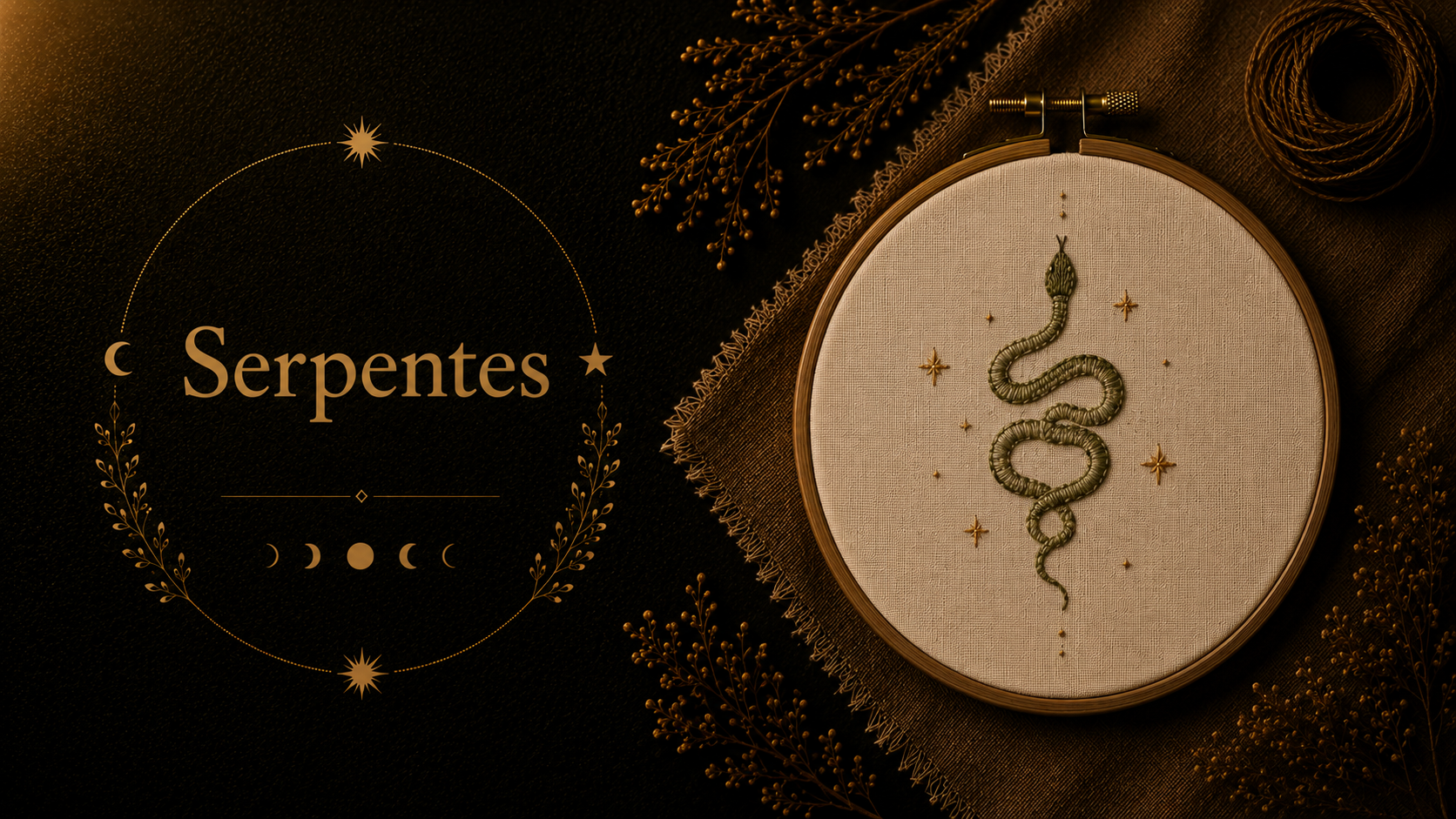
Previously, I wove some reflections on the cyclical nature of becoming and on one of the images that fascinates me most when I think about processes of transformation the spiral and the Ouroboros, the serpent that bites its own tail.
Today I want to continue this conversation along a different path, introducing another serpent from a completely different tradition Kundalini.
Although they belong to distinct cultural universes, the way both evoke ideas of energy, transformation, and continuous movement catches my attention. I do not propose any historical relationship between them here; what interests me is the symbolic dialogue these images awaken.
In yogic and tantric tradition, Kundalini is often represented as a dormant serpent, coiled upon itself at the base of the spine. It symbolizes a latent potential, an energy that already inhabits the human being and that, when awakened, travels through the body’s energy centers toward the expansion of consciousness.
What touches me most about this image is not the idea of ascent, but the fact that everything begins at the base.
Before rising, the serpent rests. Before expansion, there is grounding. Before light, there is the body. And this reading has changed the way I think about the creative process.
I came to understand that no transformation happens only on the plane of ideas. Every change must pass through the body, through time, through experience, through affections, and even through what we would rather not see in ourselves.
The image of the serpent appears in so many cultures, sometimes as a symbol of renewal as it sheds its skin. The serpent does not cease to be who it is merely by changing its skin; it simply continues its process of transformation.
It was at this point that I began to see a symbolic approximation with embroidery.
Naturally, this is not an interpretation present in Yoga traditions; it is an association that was born during my own practice with needle and thread.
While I embroider, I perceive a constant movement.
The needle pierces the fabric.
It goes down.
It disappears.
Then it returns to the surface.
It goes up.
It repeats the gesture.
Each stitch performs this same journey.
Over time, I began to see in this movement a metaphor for human transformation itself.
The needle’s descent reminds me of the plunge into matter, into that which demands patience, silence, and endurance.
The ascent brings the thread back to the visible world, making concrete what previously existed only as possibility.
Embroidery, then, ceased to be merely a finished object.
It became a gesture.
And perhaps it is precisely the gesture that transforms the one who embroiders.
I like to imagine the spine as an invisible line that sustains the body.
The needle, in turn, draws a similar line upon the fabric.
Not because they represent the same thing, but because both speak of an axis that connects different dimensions of experience.
I see embroidery as an exercise in integration. Each stitch demands presence. Each mistake teaches a new path. Each repetition modifies, however subtly, the person who is embroidering.
Further along, another image came to dialogue with this reflection.
Lilith.
Not the historical character nor the figure from different Jewish traditions, but the symbolic image that, over time, came to represent the refusal of submission and the affirmation of feminine autonomy.
It was then that I perceived an approximation that belongs only to my own way of interpreting symbols.
If Kundalini represents an energy that awakens from its own base, Lilith reminds me of the courage to recognize that force without asking permission to exist.
One speaks of the body and the other of freedom. And both lead me to the same question:
what happens when we stop denying important parts of ourselves?
Perhaps it is precisely there that becoming takes place not when we become someone else, but when we integrate aspects that have remained dormant for a long time.
That is why I continue to see the serpent as one of the most profound images of transformation.
Perhaps embroidering is, after all, a silent way of awakening what has always been waiting within us.
- SARASWATI, Satyananda. Kundalini Tantra. Bihar, India: Yoga Publications Trust, 1996. (Suggested book here)
Leave a Reply