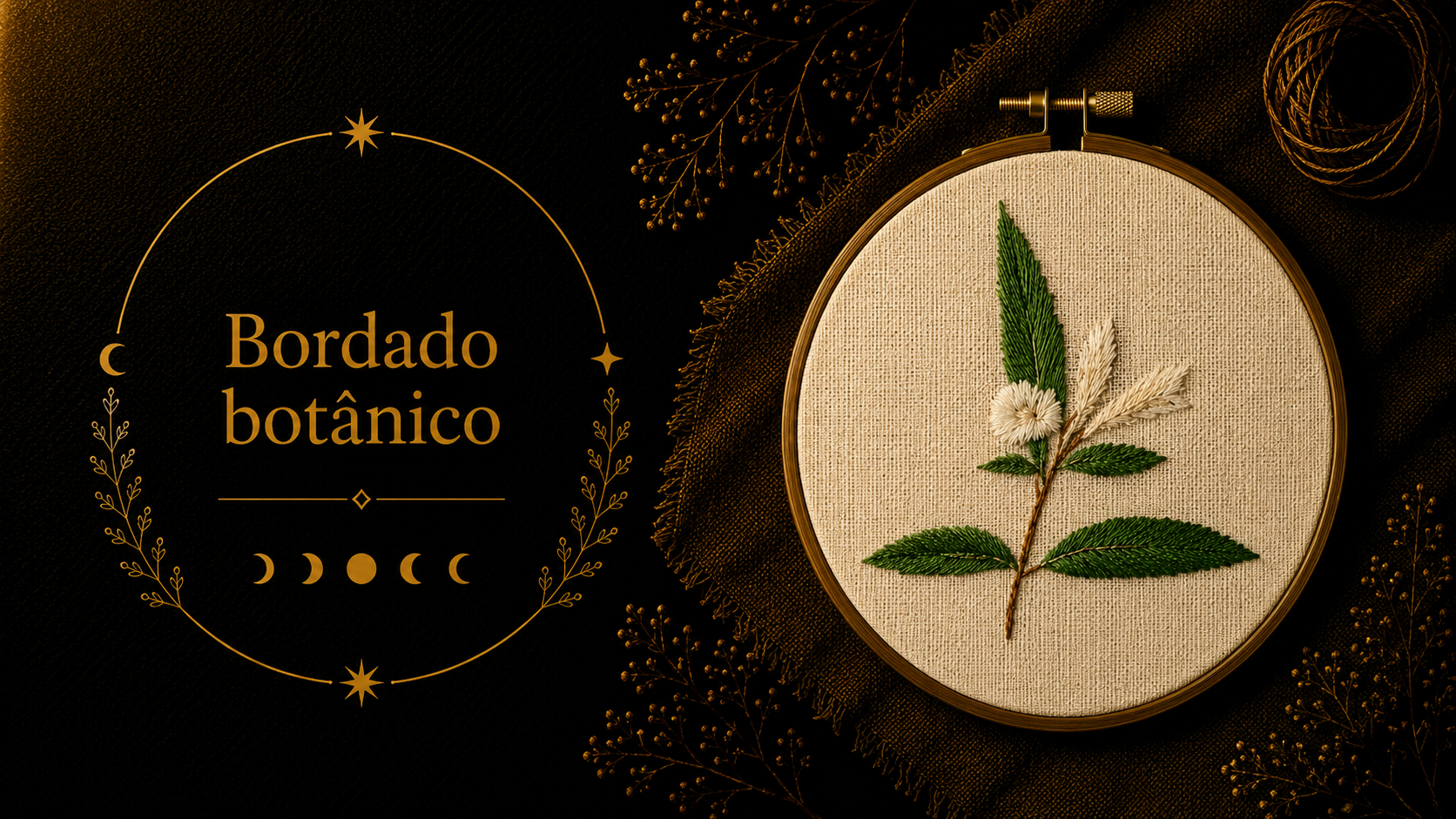
This year, almost all of my embroideries have been botanical. Leaves, flowers, branches, roots. It wasn’t a conscious decision. It just happened.
Today I think my unconscious already knew what my hands were looking for.
This story began in college.
Curiously, although I majored in Library and Information Science, it was there that I came to know exsiccatae: pressed, dried plants, mounted on paper and carefully cataloged in herbaria. It is one of the most important ways science has found to document and preserve flora over time.
It is an extraordinary method for preserving the plant’s structure and allowing its identification by generations of researchers.
But there is an inevitable limit. Time alters colors.
Chlorophyll degrades. Petals lose intensity. Green gradually turns brown, yellow approaches beige, and what remains is, above all, the plant’s form. For taxonomy, that is enough.
For the sensitive memory of the plant, perhaps not.
It was at this point that a question began to accompany me.
What if we embroidered the plants?
A well-preserved embroidery can maintain its colors for decades, sometimes much longer than a pressed plant. Green remains green. Yellow remains yellow. The flower no longer depends on chlorophyll to exist.
It was only this year that I realized that this was exactly what I had been doing. Perhaps I never wanted to collect plants. Perhaps I always wanted to collect their memory.
I’ve never been good at cultivating gardens. I don’t know how to make seedlings, and my potted plants rarely survive. But I discovered that I know how to cultivate something else.
The memory of plants.
Each embroidery ended up becoming a kind of textile exsiccata. An herbarium made of threads, not paper.
They are leaves I found along the way. Plants that were part of my childhood. Species that taught me something about time, care, and permanence.
My long-term desire is to build a botanical embroidered catalog: a textile collection of the plants that marked my life whether because they healed me, taught me, or simply reminded me that nature is not a resource. It is kin.
Later I discovered that I was not alone.
In Patagonia, for example, there is the Embroidered Library, linked to the Jardín de Nativas de Ushuaia, which uses embroidery to record plant species from the region. In different parts of the world, other artists also follow similar paths.
The English artist Katerina Knight incorporates dried flowers into her embroideries.
The Australian Meredith Woolnough recreates the delicacy of leaf veins in delicate textile structures.
The German artist Lora Avedian transforms her walks through nature into embroidered collections.
And perhaps it was Caitlin Faires who moved me most deeply. In her Herbarium project, each flower represents the affective memory of a loved one: a grandmother, a mother, a friend, a mentor.
In Brazil we have Duda, Maria Eduarda de Figueiredo, who embroiders a collection of the specific flora from each region of our country.
I realized that, each in their own way, they are all trying to answer the same question: how do we preserve a plant against time?
Exsiccatae preserve what science needs to recognize.
Embroidery preserves what memory wishes to remember.
Color. Texture. Relief. Affection.
The plant ceases to be merely a record. It becomes celebrated.
Perhaps that is why my work dialogues so much with Ossaim, the guardian of leaves in Yoruba tradition. While he protects the knowledge that springs from the earth, I try to protect the plants that have passed through my life, stitching them into fabric so they continue to exist in another way.
An herbarium preserves the species. Embroidery preserves the encounter.
- Meet Katerina Knight (Here)
- Meet Meredith Woolnough (Here)
- SILVA, A. N. F. da; ALMEIDA JR, E. B. de; VALLE, M. G. do. Exsicatas como recurso didático: contribuições para o ensino de botânica / Exsiccatae as a didactic resource: contributions to botany teaching. Brazilian Journal of Development, [S. l.], v. 6, n. 5, p. 24632–24639, 2020. (Suggested reading here)
Leave a Reply