During my undergraduate studies, I had the honor of working alongside Professor Marco Antônio de Almeida, a researcher in the fields of mediation and cultural action. In fact, I served with him as a member of the University’s Extension and Culture Committee for a certain period.
It was through this dynamic that I learned to look at the pop culture produced by humanity as something that encompasses much more than mere entertainment. That is why I justify the presence, in this space, of texts that dialogue with such distinct subjects that, at times, it may seem like I am digressing from the theme of my content.
Some time ago, I wrote a text here that is no longer available. Mainly because, amid internal and personal conflicts, I judged my voice insufficient to communicate the powerful message that reflection should have addressed.
Nothing like the passage of time to mature one’s thoughts.
Now I return to rescue that same text, but with a broader vision and a voice more directed toward what I would actually like to communicate to the world.
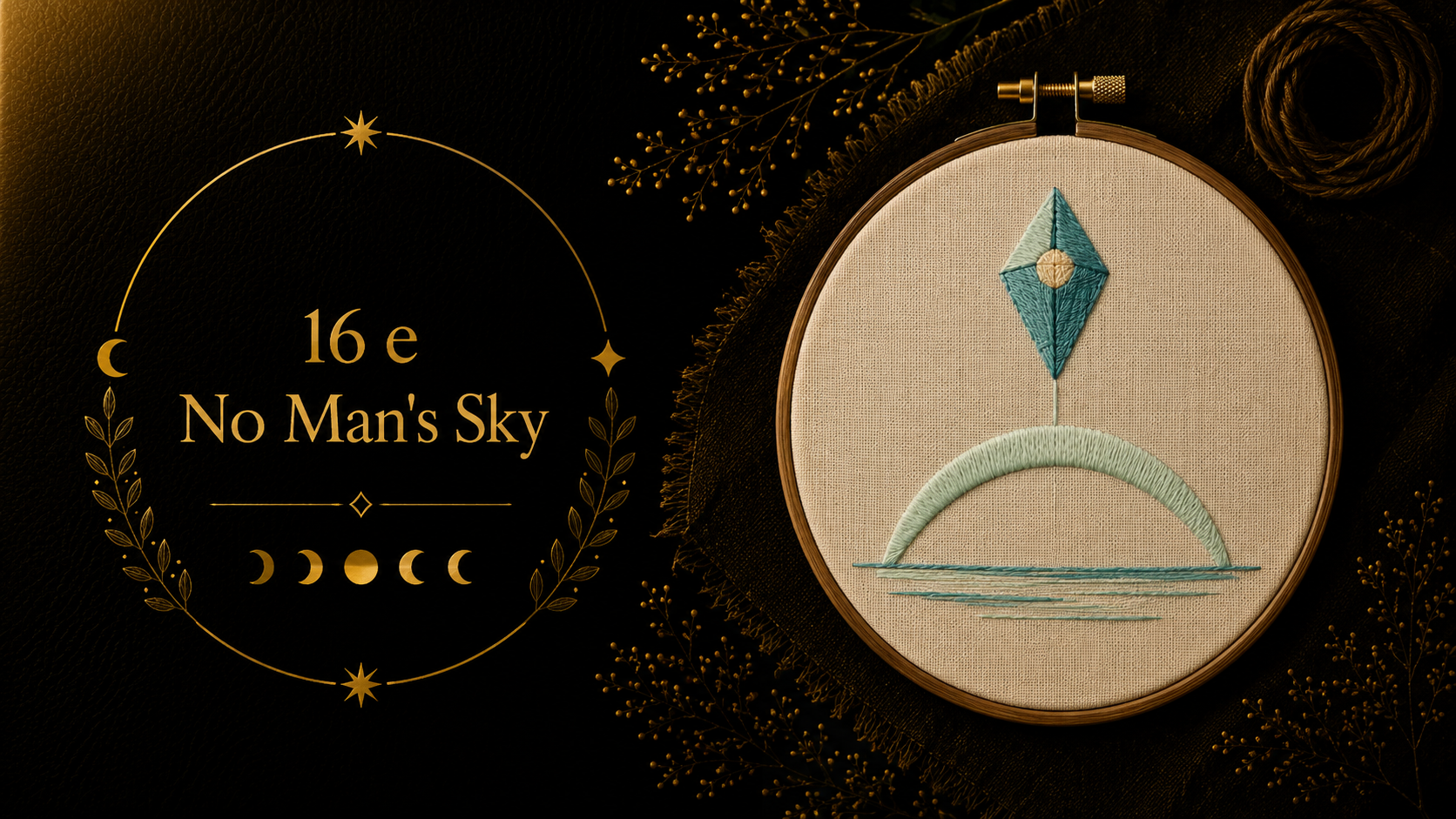
I present this reasoning by drawing a parallel with No Man’s Sky, a space exploration game released in 2016 by Hello Games. The proposal was always gigantic presenting a procedurally generated universe, formed by an almost absurd number of possible worlds.
This year, the game turns ten years old.
And the proposal remains larger than humanity’s capacity to explore it.
This interests me much more now than it did when I wrote that text months ago.
The news that marked the game’s tenth anniversary is almost poetic because, according to data released by Hello Games and echoed by the press, less than 1% of the available planets in No Man’s Sky’s universe have been visited by players over this decade.
Ten years, and millions of players, and we still haven’t come close to knowing everything given the sheer size of the franchise.
Perhaps this is where I need to return to the content I originally wrote before.
In No Man’s Sky’s universe, portals are activated by glyphs. Each combination functions as an address and allows travel to a specific planet. The game’s very structure turns these symbols into a kind of language for crossing space.
There are sixteen glyphs.
The number appears repeatedly in the game’s construction and has become a recurring element of its universe, including in a mission called 16/16. When I first thought about this subject, I even drew a parallel with the hexadecimal system used in computing, but today I don’t want to turn the number sixteen into a formula I want to observe what it opens.
Because what caught my attention from the start was precisely this: a limited set of symbols capable of producing an almost unlimited number of paths. You see, the glyphs are not the destination, but rather the possibility of reaching it.
There is another thing in No Man’s Sky that particularly draws my attention: the possibility of finding something no one else has seen.
The game allows you to record discoveries and share them with other players. You can cross an entire planet and not know if you were the first person to arrive there. You might find a landscape, a creature, a formation, or a world that, up until that moment, existed within that universe without ever having been observed by anyone.
This is curious.
Because humanity built a virtual universe so vast that even its own creators cannot exhaust it through the players.
It is almost a technological reminder of something quite ancient: that knowing is not possessing.
We can map, catalog, name, and record.
We can build entire classification systems for what we find and yet, there will always be something beyond what we manage to observe.
This idea directly converses with what I have been doing for years, because I like to find things. I like to observe, record, relate, classify, and preserve.
Ten years ago, No Man’s Sky arrived surrounded by enormous expectations and a very difficult initial reception. Hello Games itself acknowledges that the launch did not live up to what had been promised, and that the game needed to be rebuilt over the years.
Today, the game’s story is also a story of continuity there were constant updates, but also the presence of a community that remained exploring.
This adds another layer to my 16, which is not just about a gigantic universe it is about something that continues.
A project that did not end the way it began a game that had to go through its own fall to become something else. And I believe I am experiencing this process at this very moment, as I slowly restructure this space. The blog that exists now is not exactly the same one that existed when I wrote that first version, and neither am I.
I believe I was able to return to this text after so much time not to correct what I wrote before as if erasing a mistake, or to be ashamed of the writing, but to go through the same door again and discover that, on the other side, I was already someone else.
If less than 1% of No Man’s Sky’s planets have been visited in ten years, it means there is still much to discover, and I find that wonderful. Not because it means we are behind, but because discovery is the best part whether in any universe.
But in No Man’s Sky’s universe, at least the soundtrack is wonderful.
- Gfinity Esports. (2026, August 11). No Man’s Sky celebrates 10th anniversary with free Cosmos update. (Here)
- Martin, M. (2015, August 4). Here are 41 facts you didn’t know about No Man’s Sky. IGN. (Here)
- Murray, S. (2026, August 11). 10 years later, No Man’s Sky officially unveils a brand-new update. Screen Rant. (Here)
Leave a Reply