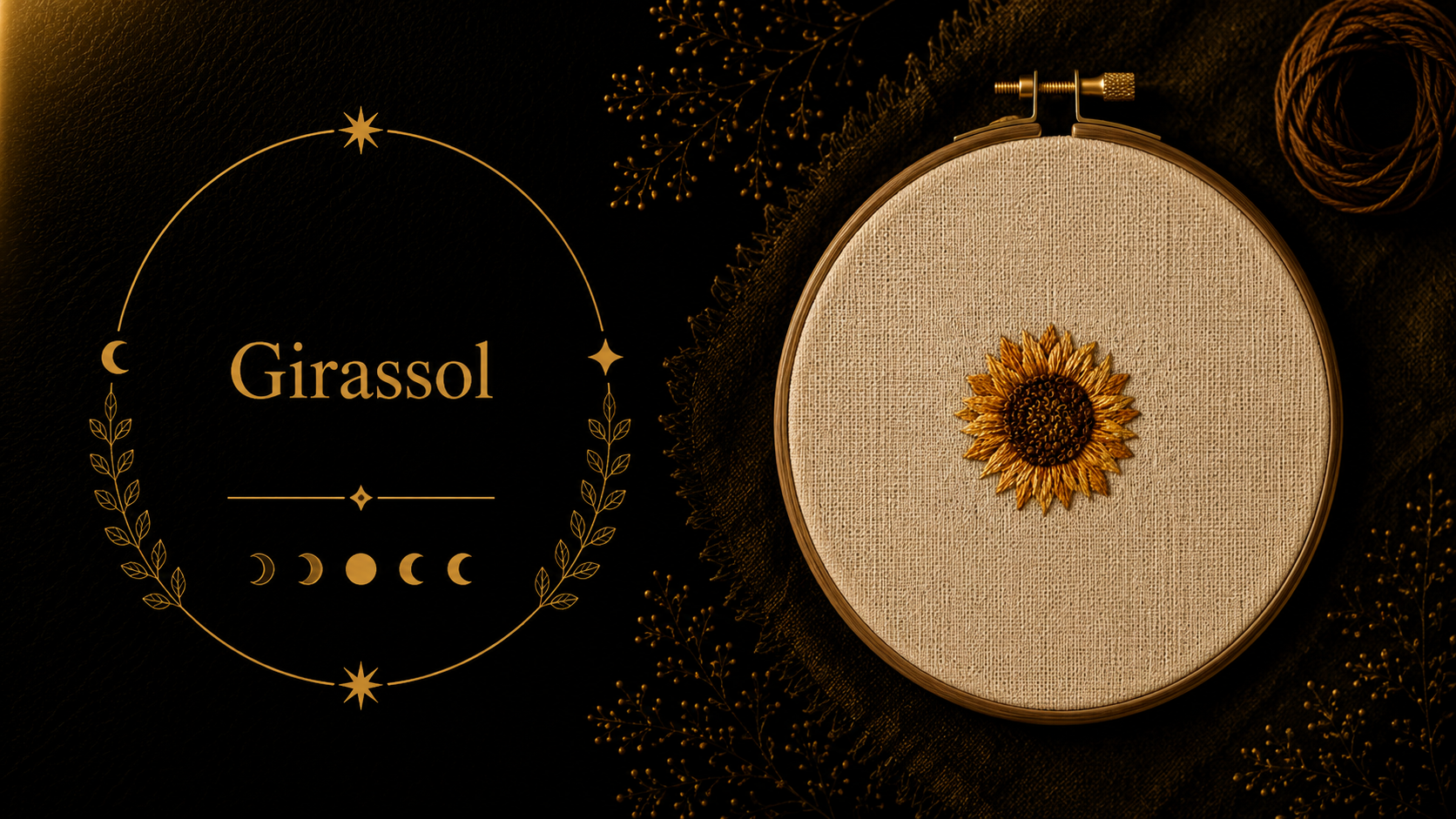
The sunflower appears in very different places.
In Van Gogh’s painting. In the Queen of Wands of the Rider-Waite Tarot. In the legend of Cabocla Jurema.
Three stories that were born in different times, cultures, and contexts, but that seem stitched together by the same thread.
I begin with the tarot.
The Queen of Wands sits on her throne among lions. In one hand she holds a staff already covered in sprouts; in the other, a sunflower. At her feet, almost hidden, a black cat observes the scene.
Nothing there seems to have been placed by chance. The staff blooms because there is life. The cat reminds us of intuition.
And the sunflower seems to represent a force that remains turned toward the light.
Then I find another sunflower.
Between 1888 and 1889, Vincent van Gogh painted a series of vases with sunflowers in Arles, in the south of France. The canvases show flowers at different moments of their cycle: some still closed, others fully open, others already drying. It is not just a vase of flowers. It is time happening.
It is birth, maturation, and farewell coexisting in the same painting.
Perhaps that is why his sunflowers remain so alive. They do not portray a perfect flower; they portray a flower living.
The third sunflower is born in a very different narrative.
In the tradition linked to Cabocla Jurema, it is said that after her sacrifice, from the place where her blood touched the earth, a sunflower grew.
Here the flower ceases to be an object. It becomes transformation.
Life does not disappear. It changes form.
I then realize that the three sunflowers occupy different places.
In the Queen of Wands, the sunflower is a companion.
In Van Gogh, it is a witness to time.
In Jurema, it is the continuity of life.
What changes is the narrative. What remains is the idea of transformation.
Curiously, there is one more layer.
When young, sunflowers follow the sun’s movement throughout the day. After maturing, they tend to remain facing east, waiting for the first light of morning.
Perhaps there is a beautiful metaphor in this.
Growing up does not always mean continuing to search in all directions.
Sometimes it means knowing where to look.
Ever since I started paying attention, I began to find sunflowers in many places. In tarot cards. In museums. In the stories I hear. On the kitchen tiles of the house where I live.
It was precisely because of them that I chose the house I live in today.
Sunflowers are a quiet way of reminding us that all life seeks light and that what truly transforms us continues to bloom long after the first encounter with it. (Sometimes there may not even be an actual encounter at all!)
- BAIRRÃO, J. F. M. H. Raízes da Jurema. Psicologia USP, v. 14, n. 1, p. 157–184, 2003. (Suggested reading here)
Leave a Reply