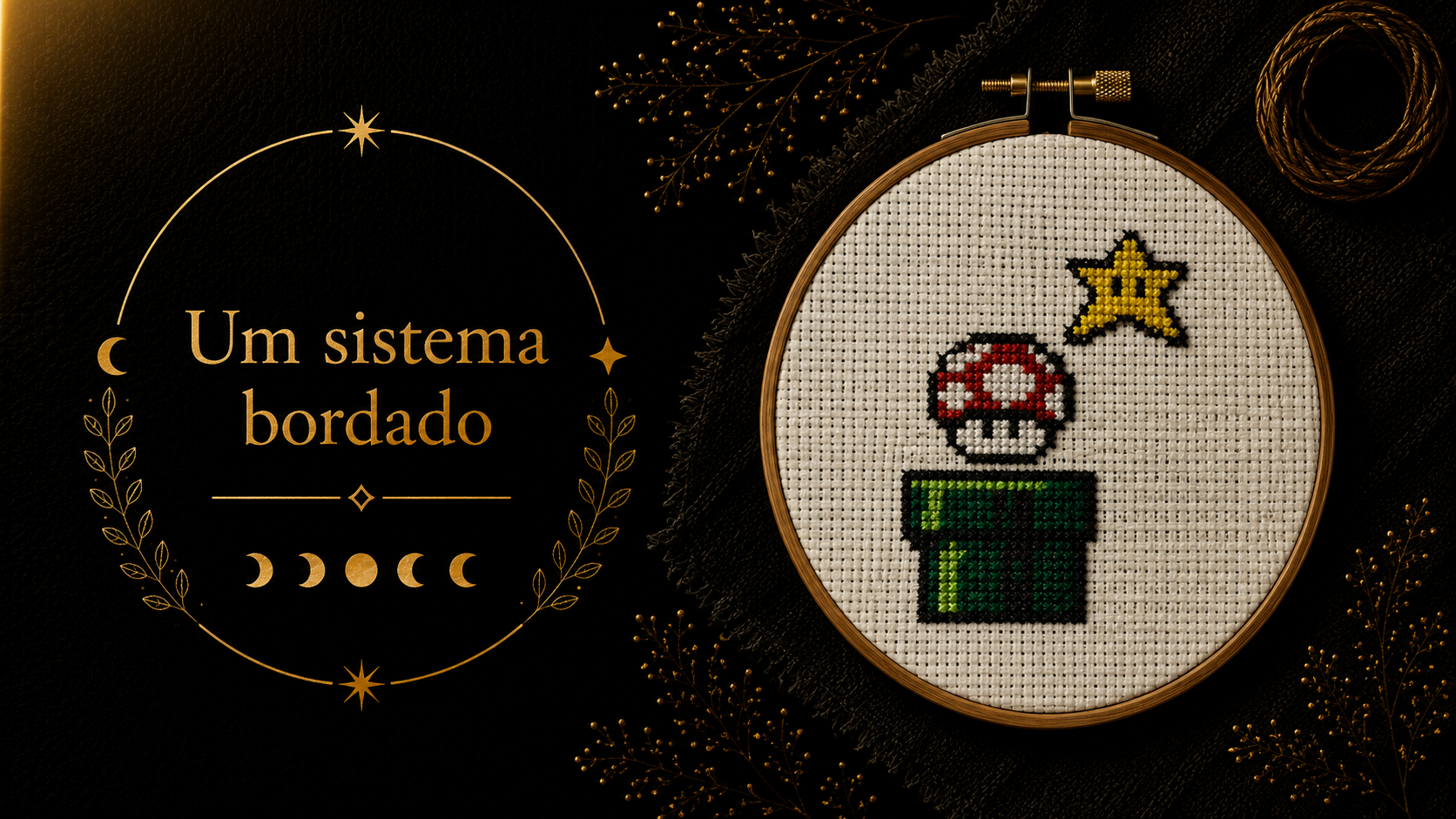
Let’s do a small exercise.
Imagine cross-stitch as an analog computational system, not because embroidery is literally a computer, but because some of its characteristics allow us to build a curiously precise analogy between a manual practice and certain principles that we now associate with computing.
Let’s begin with the simplest structure.
The fabric works as a grid, and the weave establishes the possible positions where the design will be built. The thread is the material that runs through this grid, while the needle is the instrument that executes the movement. And the cross-stitch occupies a determined position within this system.
If we think only about the presence or absence of a stitch, we can establish a binary reading. There is a stitch or there isn’t filled or empty type; one or zero.
A single stitch, in isolation, tells us almost nothing, but organize thousands of them according to certain positions, colors, and relationships, and something begins to appear. That is precisely where the analogy becomes interesting.
A discrete unit may seem insignificant when observed alone, but it acquires meaning when inserted into a larger structure. This is something that also happens with pixels in a digital image, with values in a matrix, or with bits in a computational system.
Meaning is not necessarily in the unit, but in the relationship between units.
Embroidery also has a kind of algorithm.
When we follow a cross-stitch chart, we are not simply choosing where to place the needle. We are interpreting instructions that require a position, a color, a certain quantity of stitches.
There is a possible sequence of execution.
The chart works as a map. Each square corresponds to a position within the grid, and each symbol provides information for the execution of that design. The embroiderer reads this map and transforms it into movement.
It is a translation what was represented on paper begins to exist on the fabric. And this transformation requires that visual information be converted into a sequence of physical actions.
That is where embroidery begins to resemble a language.
Not a programming language in the strict sense, but a language built by rules, positions, and relationships.
For a long time, I learned that good cross-stitch should have an impeccable back. The stitches should follow the same direction. The threads should be organized. There should be no visible knots or unnecessarily long paths.
There is a technical reason for this.
An organized back can facilitate certain stages of the work, reduce thread waste, and make it easier to identify an error or the need to undo a section.
But there is also a cultural dimension to this idea.
For many years, the perfect back was presented almost as a moral proof of the embroiderer’s skill. As if the quality of the work needed to exist also where no one would look. Today I prefer to think differently.
The back doesn’t need to be perfect to be revealing it just needs to tell something. When we look at it, we can perceive the thread’s path. Where the needle entered, where it returned.
In this sense, the back is closer to source code than simply a proof of perfection. It reveals the architecture that supports what appears on the front.
A system can have an extremely organized structure. It can have an improvised structure. It can carry temporary solutions, corrections, and adaptations. And yet the result can still work.
And that is also part of the story of how it was built.
When an embroiderer works from a chart, we can imagine a small processing cycle.
First there is input, the eyes receive information about symbols, colors, positions, and proportions. Then processing happens, the brain interprets this information and transforms what was seen into motor decisions. Finally, there is output, the needle crosses the fabric and the design begins to appear.
It is an almost computational sequence.
Except that there is a fundamental difference, because the one processing this information is a person. A person who can make mistakes, get distracted, change their mind, and decide that a certain stitch will look better another way.
They might even abandon the chart and invent something along the way.
Embroidery is structured, but not necessarily rigid.
There is yet another historical coincidence that makes this approximation particularly curious. Magnetic core memories, used as main memory in computers from the 1950s onward, were built with small ferrite rings threaded with wires and organized in matrices. Each core could represent a bit, according to its magnetic orientation. Manufacturing required such precision that the wires were passed manually through the small cores, in delicate work done with the aid of microscopes.
Information was physically organized by threads.
And at this point, the analogy ceases to be merely visual. What interests me is not to say that embroidery and computing are the same thing, but to realize that both can transform a weave of minimal elements into a structure capable of holding information.
In embroidery, the thread crosses the fabric and produces an image. In core memory, the wire crosses the cores and participates in the construction of a matrix capable of storing data. In both cases, there is an intelligence of organization. The difference is what each system makes emerge.
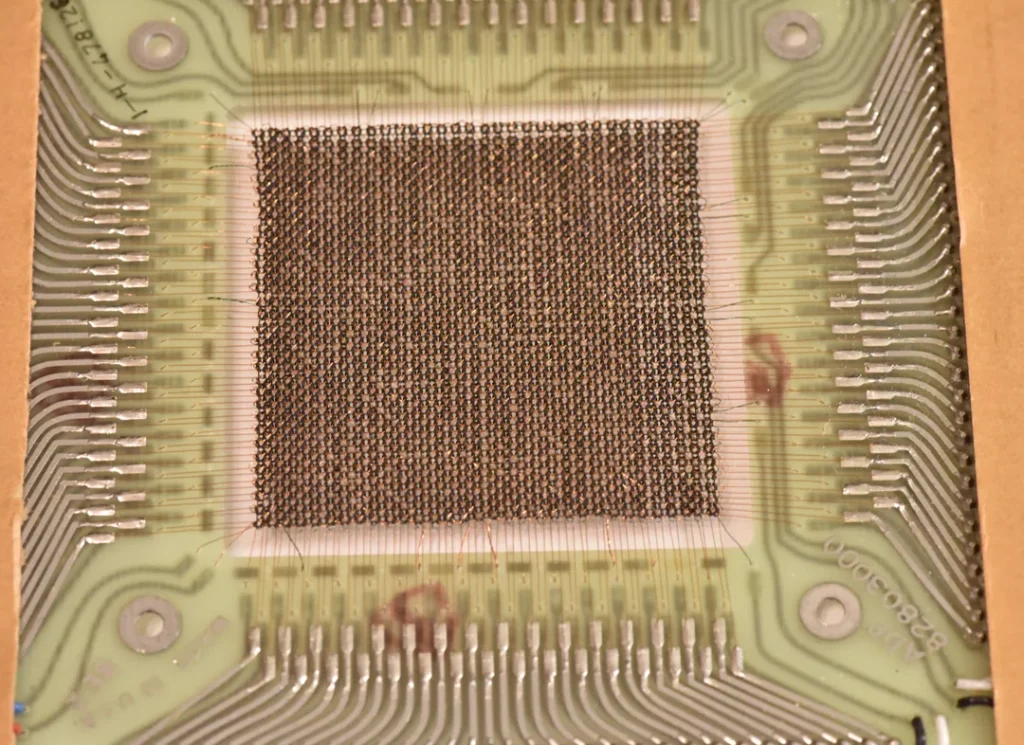
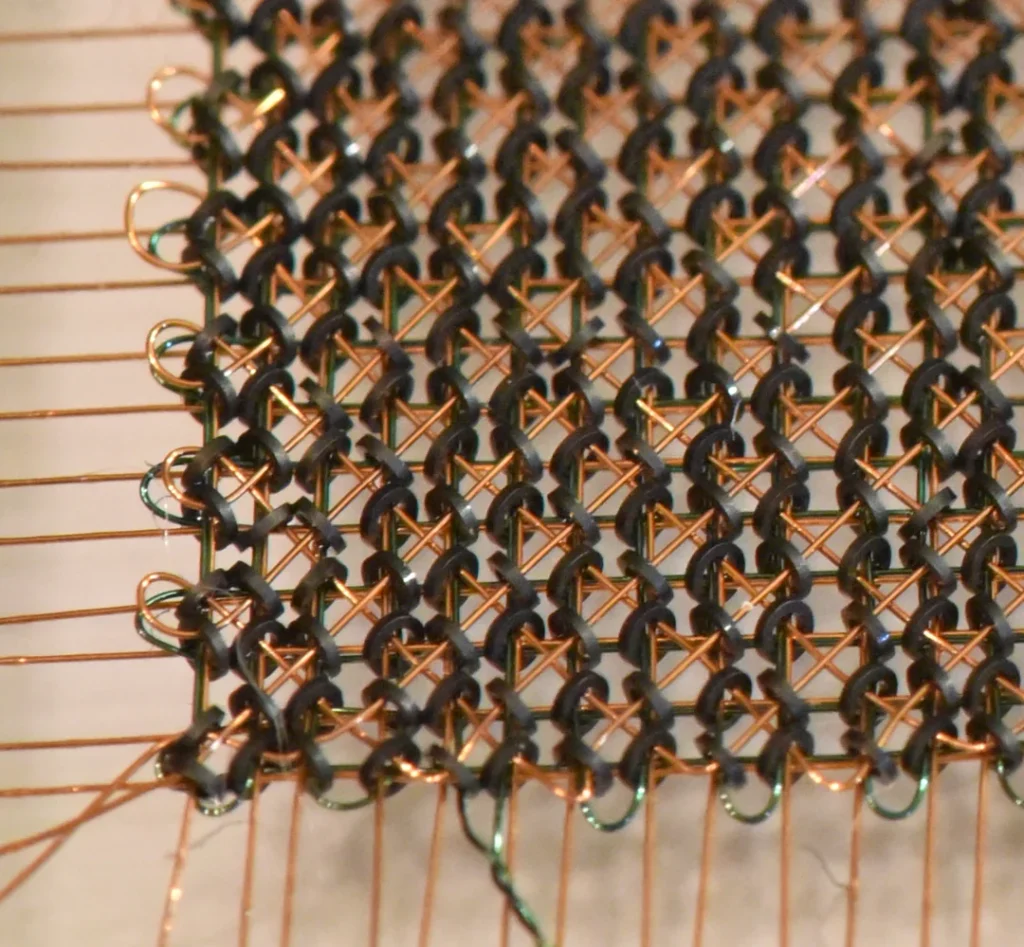
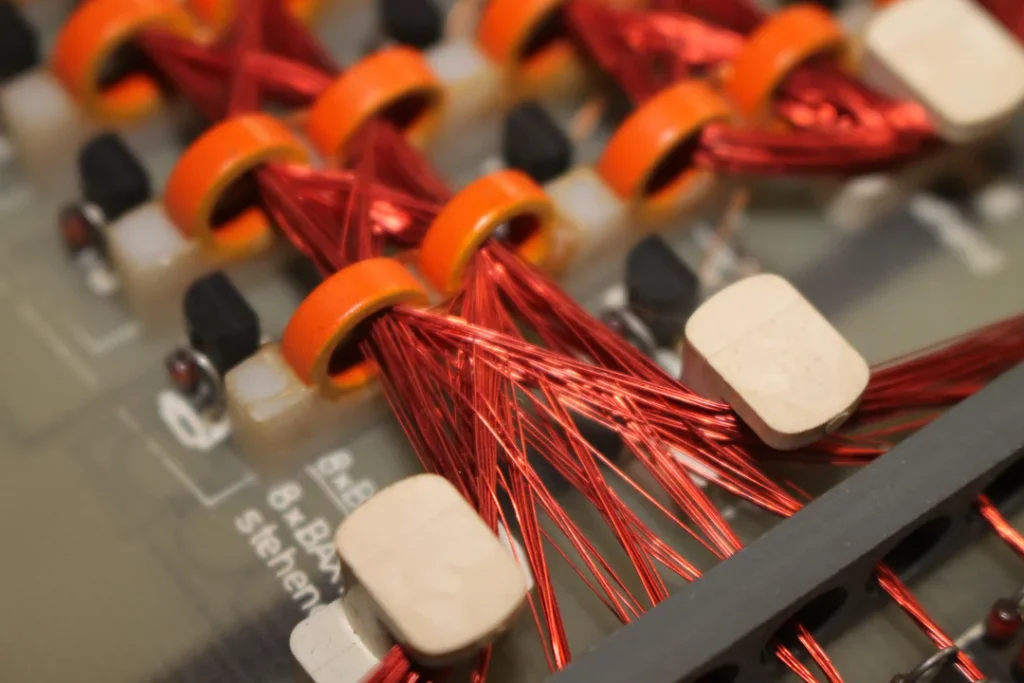
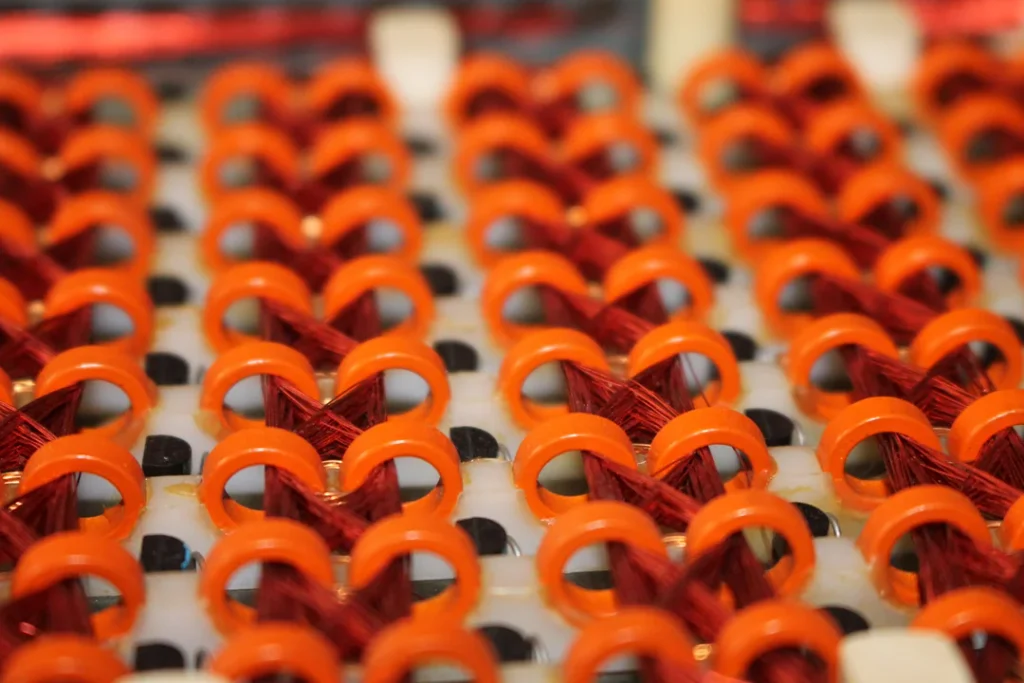
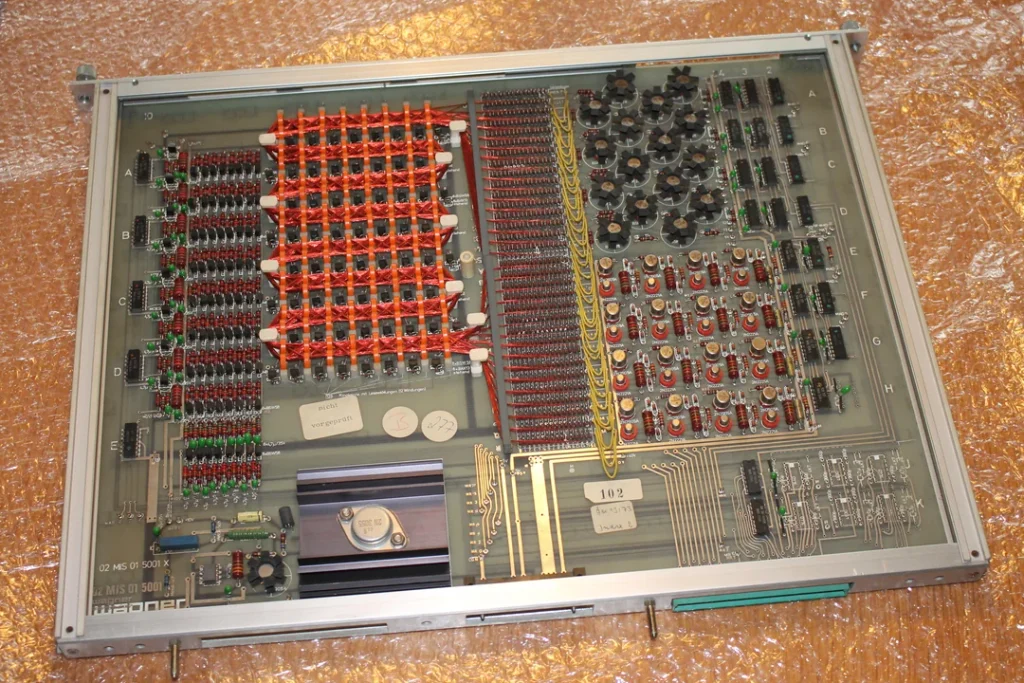
Sources: reddit/Images: Zentralschaden and dylanjames
But there is something that this analogy cannot fully explain.
A computer executes instructions. An embroiderer interprets, and to interpret means to introduce experience.
Two people can receive the same chart and produce different works. They can choose different paths to execute the stitches, manage the thread in different ways, alter small decisions, and develop their own strategies.
The system remains. But if the person changes, the way the system happens also changes.
Perhaps that is precisely where embroidery ceases to be merely an interesting comparison with computing and returns to what it has always been for me.
A way of thinking.
Because when an embroiderer makes a cross-stitch, she is simultaneously working with matter, space, time, repetition, memory, calculation, and movement.
Each stitch is small, but the whole is immense.
And why is the embroiderer writing this text?
If you guess what she has been doing…
Hint: it involves neither fabric nor thread.
But perhaps it involves exactly what embroidery has always taught me to do.
Building something from small units, recognizing patterns, organizing information, and discovering what emerges when they finally find a place next to one another.
Perhaps embroidery is not a programming language.
But it is certainly one of the most beautiful languages I have found for thinking about how things are built.
Leave a Reply