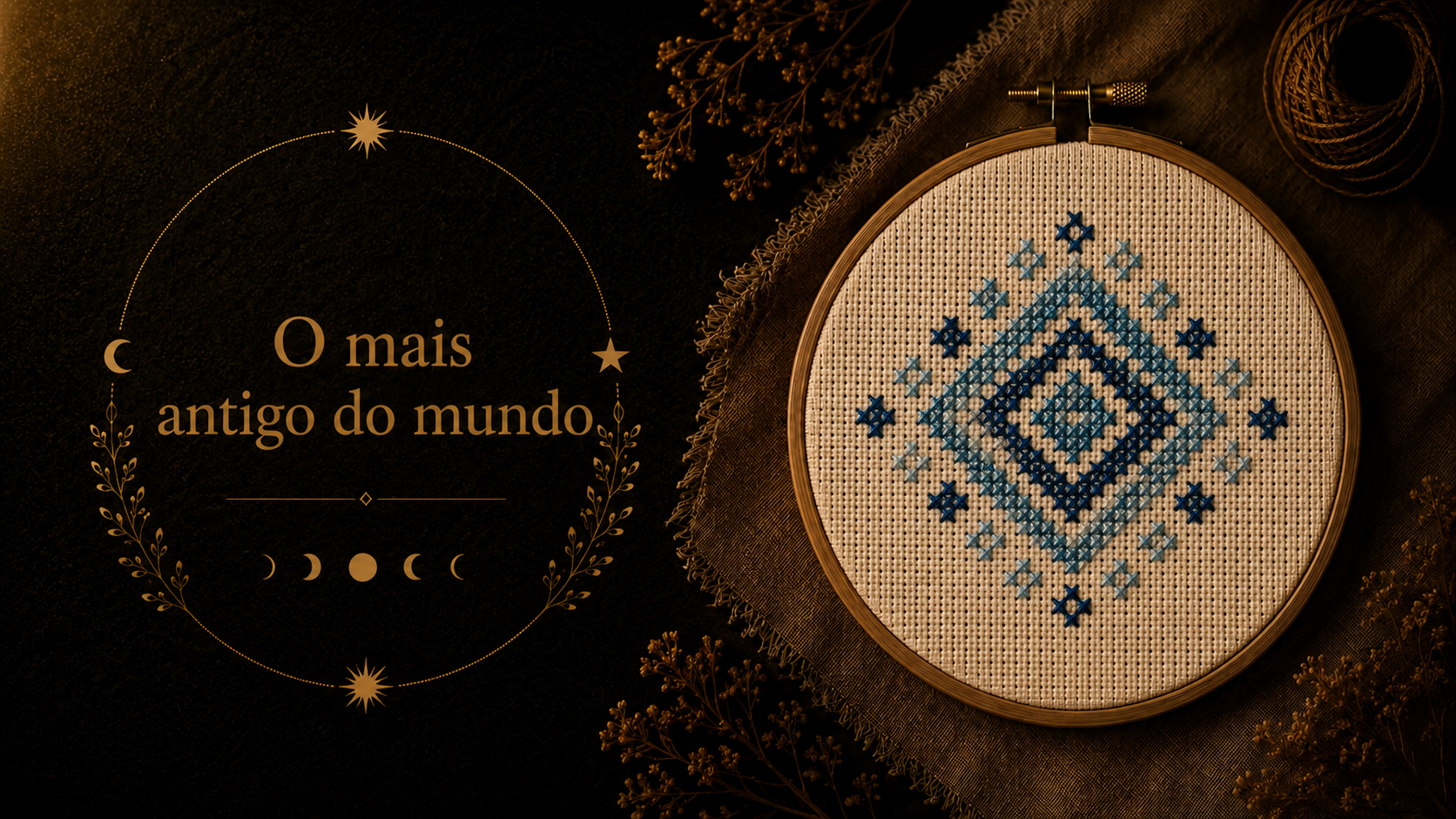
The history of embroidery is older than any written memory.
Among the stitches still used today, cross-stitch is often pointed out as one of the oldest techniques. But even before fabrics existed, early humans were already joining hides and leathers with natural fiber threads.
Needles were made of bone, some up to 30,000 years old, from the Paleolithic period. (Yes, you read that right, 30,000 years.)
The oldest archaeological records of textile work appear in different regions of Eurasia and the Near East, along the banks of the Euphrates River. Greeks, Romans, Egyptians, Chinese, Indians, and Persians embroidered as a form of tradition. The Bible itself describes embroidered curtains in purple and linen. In the Middle Ages, the Catholic Church used embroidery to display power, employing gold threads, pearl beads, and other rare and expensive items that only priests could acquire.
And in Brazil? Many people think that embroidery arrived with Italian immigrants. But before colonization, Indigenous peoples already had a very rich textile art, especially feather art in the Amazon and the Cerrado. Caminha’s Letter already described, in 1500, “a cloth of feathers of many colors, in the manner of a quite handsome fabric.”
In the context of Portuguese colonization, many Indigenous practices were marginalized or replaced by European techniques taught in religious missions. Jesuits, Benedictines, and Franciscans taught needle embroidery as part of the “civilizing project.” Indigenous and enslaved labor, but European technique.
With the Industrial Revolution, manual labor was devalued, and machines produced more pieces in less time. But curiously, it was also during this period that magazines began to be published with patterns for embroidering at home, most of them teaching cross-stitch, the oldest of them all.
In the 19th century, embroidery became part of female education, and the law sanctioned in 1827 made it the State’s obligation to educate women, but in practice it was religious institutions that taught embroidery to shape good wives and mothers.
In the Northeast, the cangaço gave embroidery another meaning. Men and women from the group embroidered their garments, including the famous leather hats and tooled leather aprons. Proof that embroidery was never “just a woman’s thing.”
With the internet, in the 1980s and 1990s, embroidery software and machines emerged. But magazine stands remained popular for a long time. Who has never seen an “Agulha de Ouro” (Golden Needle) at the newsstand downtown? Today you can take any photo and turn it into cross-stitch through the Pic2pat website. Physical magazines are disappearing, but the memory of embroidery remains alive.
Embroidery has crossed 30,000 years. It has been the ostentation of kings, the prayer of nuns, the resistance of cangaceiros, and the domestic imprisonment of women. Today it returns to our hands as a choice. The needle is the same. It is the one who embroiders who has changed.
And you, when you pick up the needle, whose heritage do you feel?
- BIBLE. Holy Bible. Benedictine Monks of Maredsous (Belgium). 23rd edition. São Paulo: Claretiana, 2015. Book of Exodus, Chapter 38, verse 18. (Bible for you read the verse here)
- BRAZIL. Ministry of Culture. The letter of Pero Vaz de Caminha. Brasília: MEC, [n.d.]. (Here)
- PEREIRA, C. N.; TRINCHÃO, G. M. C. Embroidery as an educational tool in Brazil between the 19th and 20th centuries. Revista História da Educação, [S. l.], v. 25, p. e101244, 2021. (Suggested reading here)
- SOUSA, Juliana Padilha. Invisible wefts: embroidery and the memory of the feminine in the creative process. Supervisor: Benedita Afonso Marins. 2019. 164 p. Dissertation (Master’s in Arts) – Graduate Program in Arts, Institute of Arts Sciences, Federal University of Pará, Belém, 2019. (Suggested reading here)
Leave a Reply