The more I observe the world, the more I find images that speak about transformation in different cultures, mythologies, and symbolic traditions.
Not because they tell the same story, but because they seem to try to answer, each in their own way, a deeply human question: how do we transform without ceasing to be who we are?
That is how I read symbols.
I do not seek to prove historical relationships between them, nor to suggest that they belong to the same tradition. What interests me is perceiving how different peoples materialized similar experiences through narratives, images, and myths.
It was along this path that the Eye of Horus and Matinta began to converse within me.
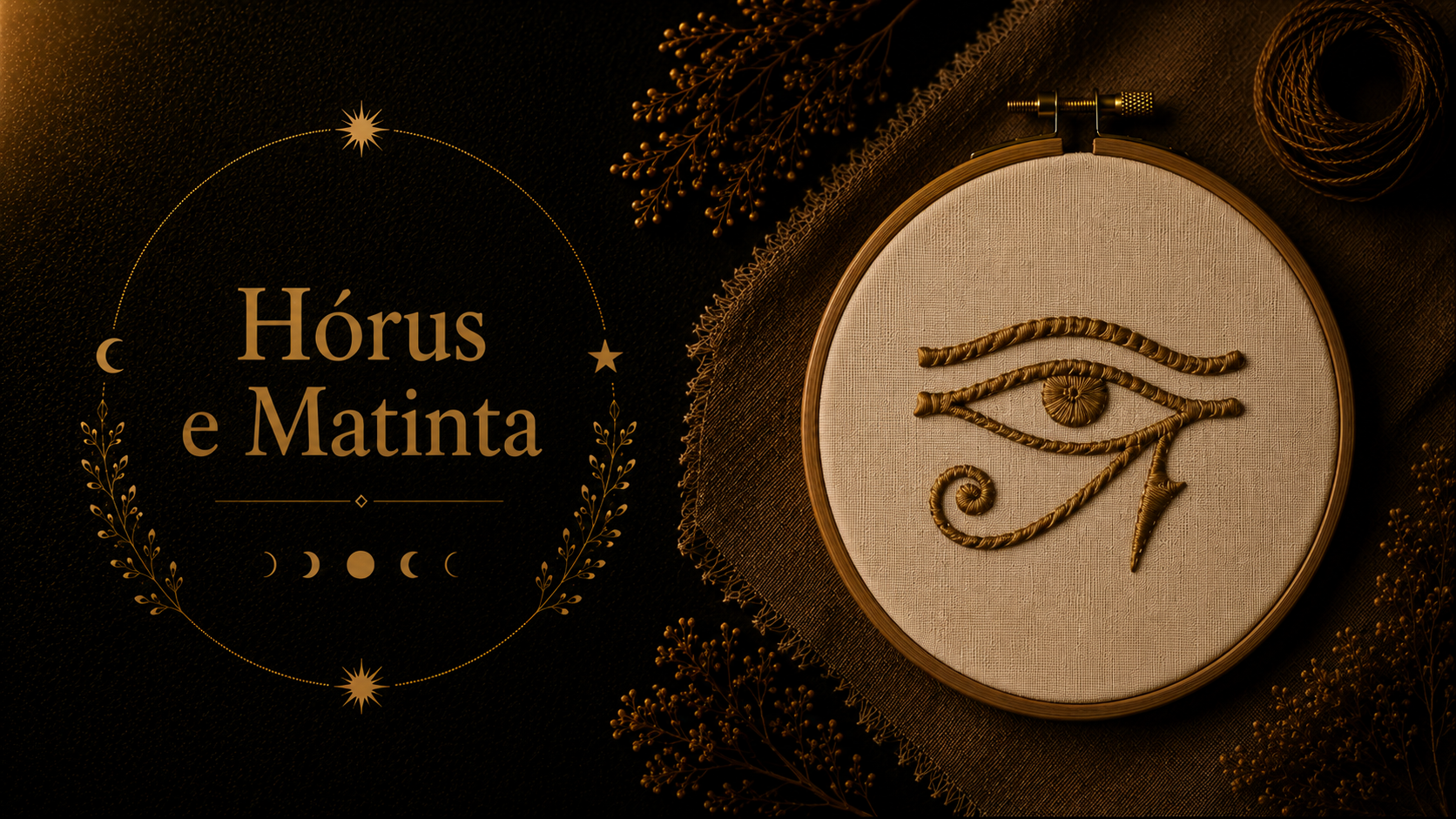
Imagine walking through the city center and entering a store selling religious or esoteric items, and among crystals, incense, and amulets, you find a necklace whose pendant is an Eye of Horus.
Many people know this symbol as a protective amulet, and that is one of its possible readings, but for me, its power lies elsewhere.
In Egyptian mythology, Horus wages a battle against Seth during the process of restoring order after the death of Osiris. In this confrontation, he loses one of his eyes. Later, Thoth takes part in its restoration, allowing Horus to once again present himself as a whole being.
Regardless of the different versions of this myth that exist, the symbolism of this gesture has always caught my attention.
I read this narrative as an image of transformation.
The restored eye does not simply represent a return to the previous state. After the loss, Horus remains Horus, but he is no longer exactly the same, because the experience of rupture becomes part of who he is.
Perhaps that is why the Udjat is often translated as “whole,” “healthy,” or “restored.” The symbol awakened my interest precisely because of the ability I see in it to serve as a metaphor for the human capacity to rebuild oneself after loss.
And the eye never remained only in Egypt it continues to exist whenever someone goes through a crisis, reorganizes their life, and discovers a new way of remaining whole.
It was this same reflection that led me to think of Matinta.
Matinta Pereira, or Mati Taperê, as I prefer to call her, belongs to the rich universe of Amazonian cosmologies. There are many versions of her story, which vary according to region and oral tradition, but the one I rely on most is the one in which Mati takes the form of a nocturnal bird and roams the night announcing her presence through a characteristic whistle. Upon hearing Mati’s whistle, the residents of the houses ask her to go away, promising to give her something in return if the whistling ceases. The next day, she returns to human form to collect what was promised to her.
I do not propose here any historical connection between Matinta and Horus.
The two figures belong to completely different worlds.
What interests me is something else.
By placing these narratives side by side, I perceive that both use images of transformation to think about profound changes in human experience.
In one tradition, transformation happens through restoration; in the other, through metamorphosis.
They are different paths to symbolize something similar where no one goes through a transformative experience and remains exactly the same.
The anthropologist Luís da Câmara Cascudo shows how the narratives of Matinta dialogue with different influences present in the formation of the Brazilian imaginary. These multiple layers make the character even more interesting, as they reveal how the stories themselves also transform over time.
Symbols never remain motionless they travel between cultures, change meaning, receive new interpretations, and continue to produce meaning for very different people.
By observing this movement, I begin to recognize becoming, not as an exclusive characteristic of Horus or Matinta, but as a way of looking at human narratives.
Deep down, I am not trying to find out whether two symbols are the same.
I ask myself why peoples so distant from one another created images capable of speaking, each in their own way, about loss, reconstruction, and transformation.
And you?
Is there any story, symbol, or image that has accompanied you for many years and that, today, has come to mean something completely different?
Leave a Reply