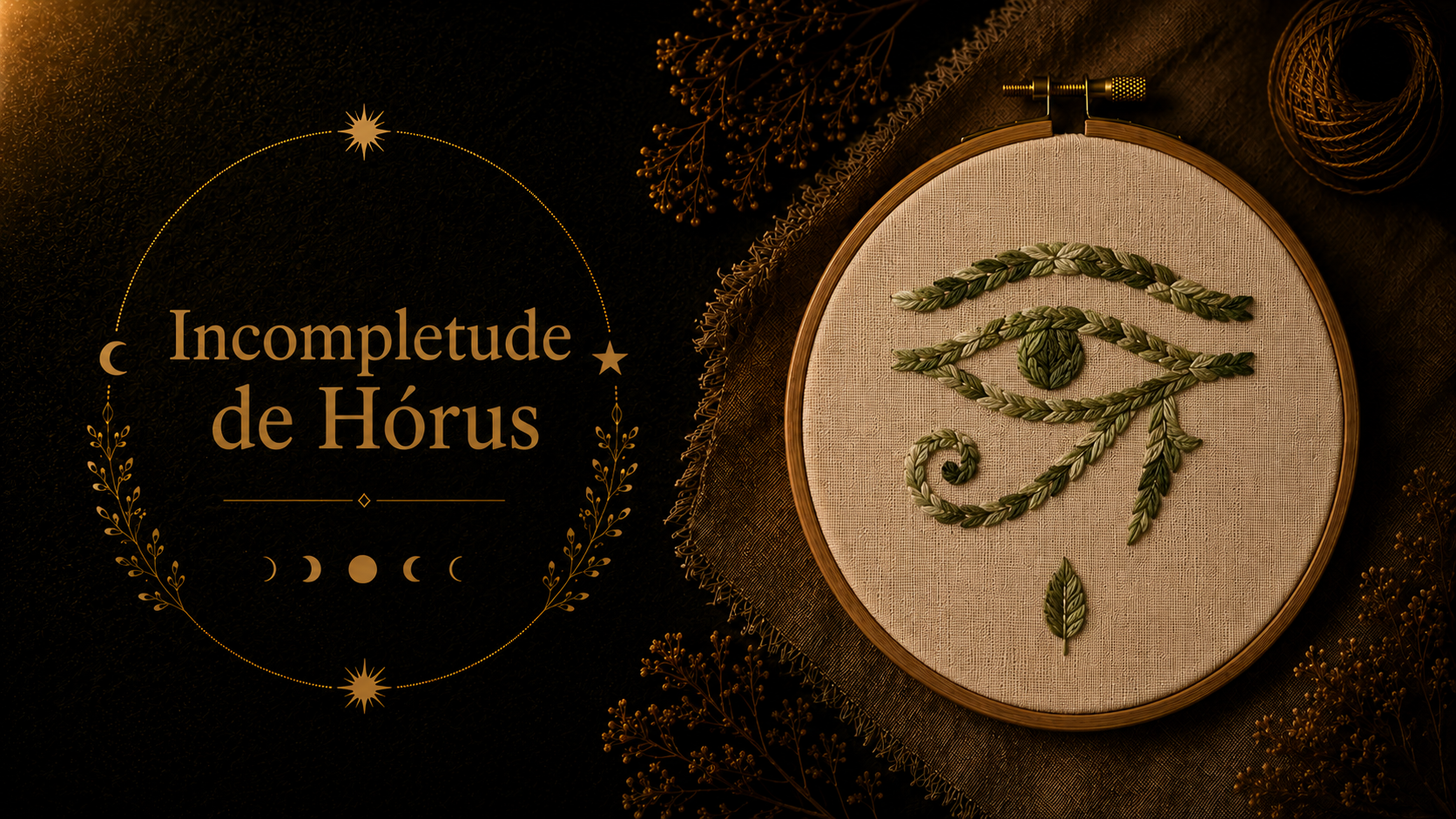
Have you ever stopped to think that even the most ancient symbols carry a philosophy of incompleteness?
The Eye of Horus, one of the best-known symbols of Ancient Egypt, holds a detail that often goes unnoticed. And it was precisely this detail that transformed the way I think about the idea of being “whole.”
Egyptian scribes divided the eye into six parts, each associated with a fraction:
1/2 + 1/4 + 1/8 + 1/16 + 1/32 + 1/64.
When we add these fractions, the result is 63/64.
Exactly 1/64 is missing.
The question arises almost on its own: why would a people recognized for the rigor of their calculations represent such an important symbol in a seemingly incomplete way?
Scholars offer different interpretations. Some associate this 1/64 with the “magical” portion restored by Thoth after the battle between Horus and Seth. Others understand this absence as a way of indicating that absolute perfection belongs only to the divine plane.
I like to look at this symbol from another path.
When Horus loses his eye during the battle against Seth, something breaks definitively. But Thoth does not return the old eye. He creates a new one.
This difference is important.
Horus does not return to what he was before. He remains Horus, but now he is someone transformed by the experience itself. The loss becomes part of who he is. The symbol ceases to represent only restoration and also begins to speak about that which never returns exactly as it was.
This is how I read that 1/64 that remains open.
Not as a flaw, but as a possibility.
How often do we demand of ourselves that we are not yet “complete”? How often do we believe that something is missing for us to finally start living?
For a long time, I thought that way too.
Then I realized that perhaps it is precisely the unfinished experiences, the unanswered questions, and the marks of the journey that keep us moving. If one day we were completely ready, perhaps there would no longer be room to learn, create, or transform.
In embroidery, this perception appears very concretely.
Each piece ends, but none concludes the journey. When one embroidery ends, another begins. Each work carries something from the previous one, but never repeats it. The movement continues.
Completeness is not a destination. It is a direction.
The 1/64 that remains open does not represent an absence. It represents what can still be born. It is the space where experience continues to happen. It is the openness that allows us to keep learning, creating, embroidering, and living.
Next time you come across the Eye of Horus, perhaps you won’t need to ask only what it protects.
Perhaps it is more worth asking: What still remains open in me?
Because perhaps it is precisely this openness that keeps life in motion.
- REFAEY, K. et al. The Eye of Horus: The Connection Between Art, Medicine, and Mythology in Ancient Egypt. Cureus, Palo Alto, v. 11, n. 5, p. e4731, 2019. (Suggested reading here)
Leave a Reply