It depends.
When we speak of becoming, we are speaking of transformation, but transformation does not mean a straight path. Many processes in life return continuously, though never in the same way, and that is precisely why I also understand becoming as a cyclical movement, yet without ever closing the circle, more like an ascending spiral.
Various religious, philosophical, and symbolic traditions use images of cycles to think about existence, and although they belong to very different contexts from one another, they all offer interesting metaphors for reflecting on the movements of change. Some of them have come to deeply dialogue with my own understanding of becoming.
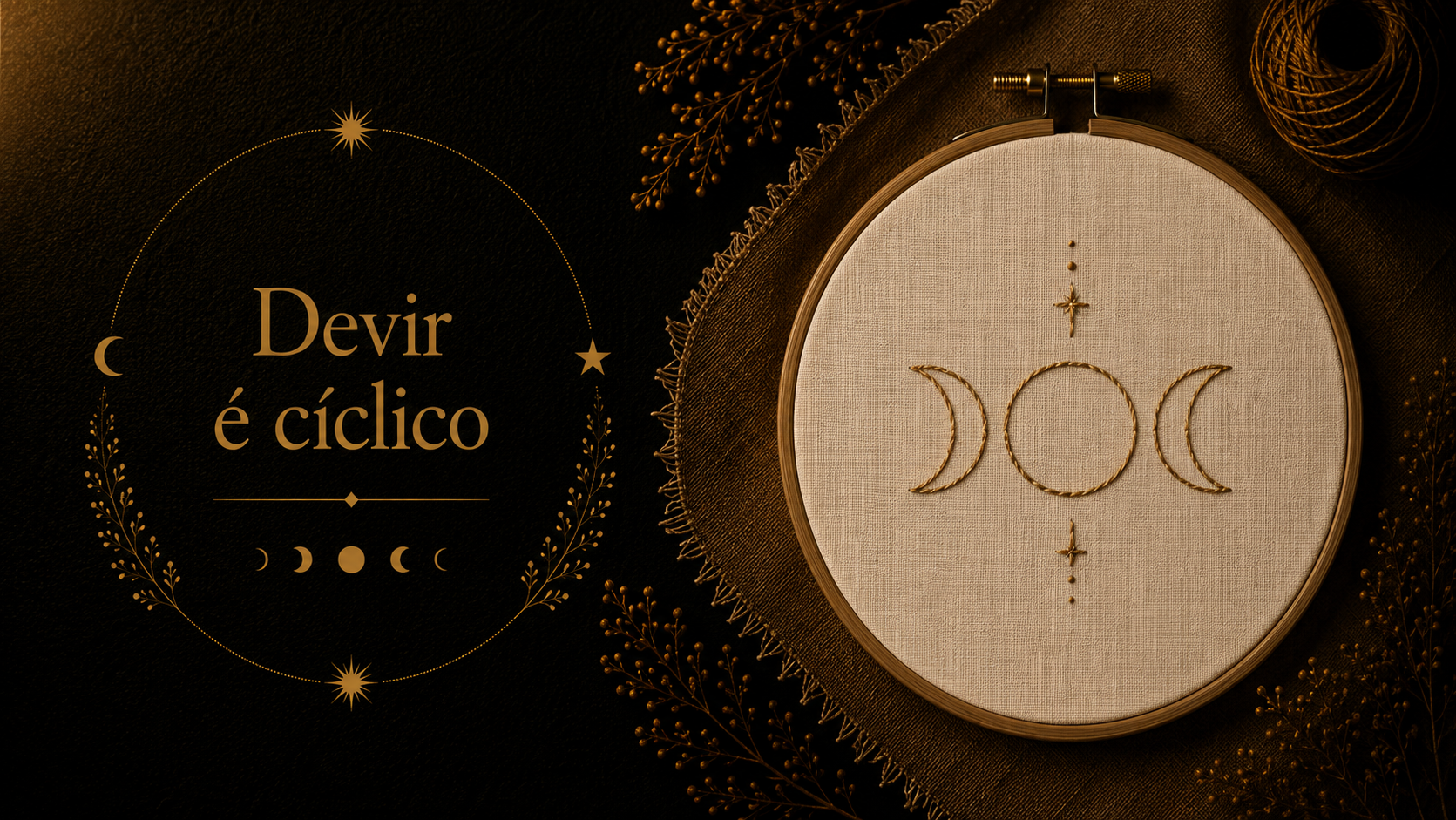
In Wicca, for example, we find the figure of the Triple Goddess, often represented by the waxing, full, and waning moons. These phases symbolize different moments of existence, drawing parallels with the faces of the goddess as maiden, mother, and crone; where it is possible to perceive the life stages of an individual young, then mature, and then in old age. More than a chronological sequence, this image invites us to think that a single life passes through various forms of being over time.
The Moon itself also offers me a powerful metaphor, for over the course of a year we experience, on average, twelve lunar cycles. I notice that the Moon repeatedly returns to the same phases, but never exactly the same at certain times it seems more golden, at others, whiter, reddish, or pinkish. It returns, but it returns transformed.
I see in this repetition an image very close to what I understand as becoming, for something similar happens with the body’s cycles.
The menstrual cycle, for example, has a variable duration among women and can also vary throughout a single person’s life. But various traditions have established symbolic relationships between the menstrual cycle and the phases of the Moon. Some contemporary currents call cycles that begin on the New Moon “White Moon” and those that coincide with the Full Moon “Red Moon.” Regardless of these symbolic classifications, what interests me is perceiving that each bodily cycle is unique. The body never returns exactly to the same previous state. Each month, it reorganizes itself, responds differently to lived experiences, and continues its permanent process of transformation.
It is in this sense that I come to perceive becoming in the body, in nature, and in life’s processes.
Thinking of symbols that represent this continuous movement, few seem as expressive to me as the Ouroboros, the serpent that bites its own tail.
For me, the Ouroboros has become one of the most potent images for thinking about becoming. Not because it philosophically explains this concept, but because it symbolizes an incessant movement of creation, dissolution, and renewal. It is not a motionless circle, but a permanent flow in which every end also inaugurates a new beginning.
In the alchemical tradition, the Ouroboros often appears associated with the union of opposites and the continuous transformation of matter and spirit. This image deeply dialogues with the way I understand human processes of change, as expressed in my view that we do not return to the starting point; we return modified by experience.
At first glance, the spiral looks like a circle, but it is not, because each turn brings the movement closer to a new point, without ever exactly repeating the previous one that is why this image represents my thinking about becoming.
Becoming does not eliminate cycles but gives them depth, and each phase of life leaves something behind while, at the same time, preparing what is yet to be born.
The possibility of accompanying, stitch by stitch, a process of transformation in an embroidery piece is fascinating, because where there was once only fabric and accumulated thoughts, it gradually becomes image and flow.
And you? Is there any cycle in your life that today asks to be lived in a different way?
Leave a Reply