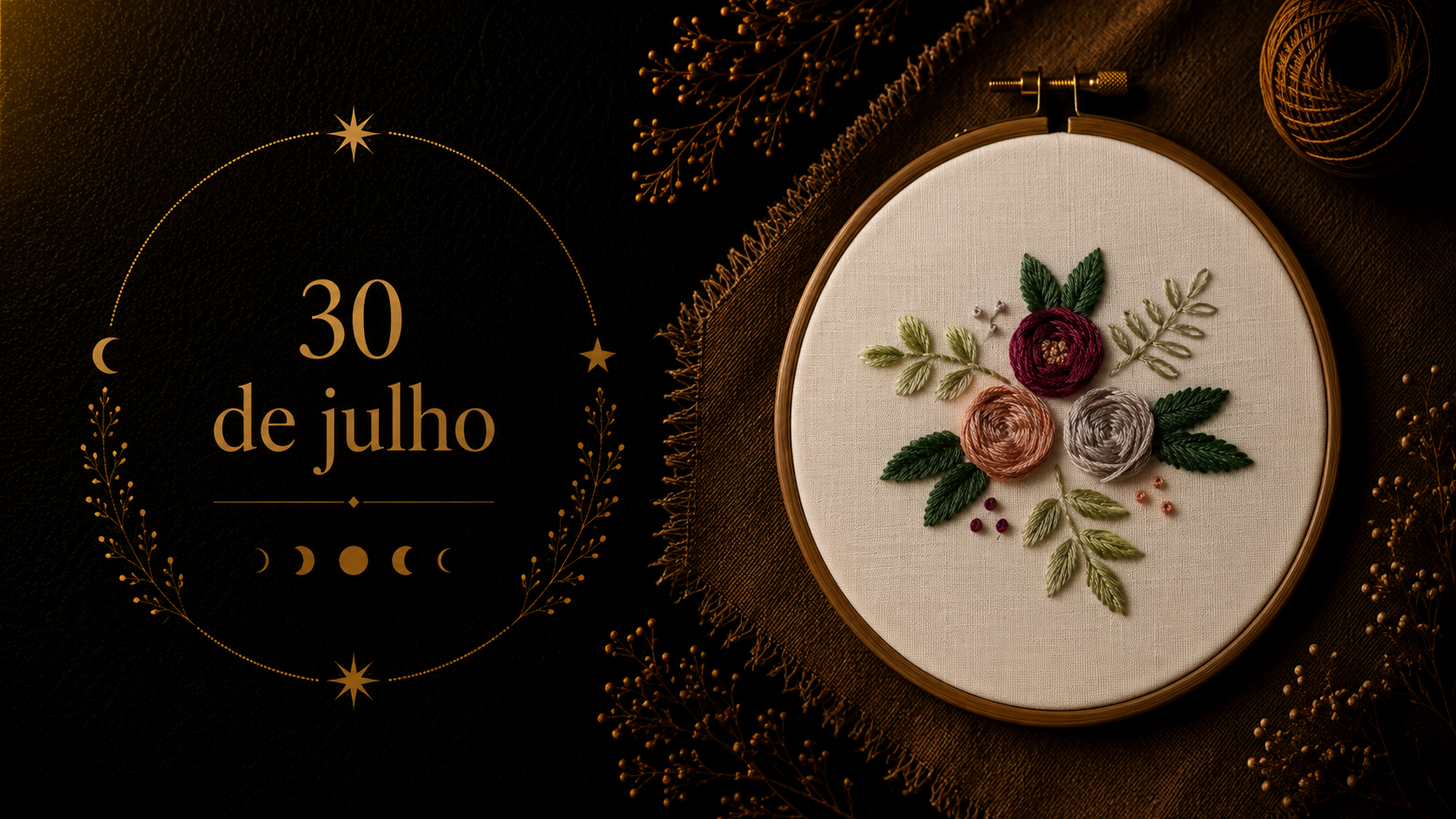
July 30.
Somewhere in São Tomé and Príncipe, someone starts a new embroidery. In a library in Canada, a group gathers to sew and chat. In England, a museum opens space for workshops. In different cities across Brazil, needles pierce fabrics, hands meet, and stories continue to be told.
Perhaps, on this very day, you too will pick up a needle.
Not because you need to finish a piece, but because July 30 is World Embroidery Day.
The date was created in 2011 by the Täcklebo Broderiakademi in Sweden, with a simple and beautiful proposal: to celebrate embroidery as a language capable of bringing people from different cultures together. Since then, museums, schools, collectives, and embroiderers around the world have marked this day with gatherings, workshops, and actions dedicated to the art of embroidery.
But perhaps the most interesting thing is to realize that all these people, even without knowing each other, repeat the same gesture.
They thread a needle.
It is a small gesture. Silent. Almost always slow.
And yet, it spans centuries.
Embroidery has never been merely a manual technique.
It records stories, preserves memories, expresses affections, and transforms fabrics into documents of human experience.
When I embroider a leaf, I am not merely reproducing a plant.
I am trying to preserve what time usually erases.
Herbaria preserve the shape of plants, but their colors fade over the years. Embroidery takes a different path: it conserves color, texture, relief, and also the memory that plant carries.
I like to imagine that, on World Embroidery Day, thousands of people will be doing exactly the same thing each in their own way. Some will produce works of art. Others will just be mending a piece of clothing. There will be those who embroider out of family tradition, those who embroider as a profession, those who embroider to rest their minds, or simply because they enjoy the silent company of thread.
None of these reasons is greater than the other.
They all keep alive a practice that spans generations.
As long as there is someone willing to thread a needle, there will also be someone preserving a memory.
And perhaps that is the true celebration of World Embroidery Day.
Not merely celebrating a technique.
But remembering that every stitch is a small form of permanence.
Happy World Embroidery Day!
- FADEL, Joice Tesseroli. O BORDADO COMO REEXISTÊNCIA: AUTORIA E MEMÓRIA EM NARRATIVAS TÊXTEIS DE MULHERES NO CONTEXTO DA EXTENSÃO UNIVERSITÁRIA. Revista Conexão UEPG, v. 22, n. 1, p. 01-16, 2026. (Suggested reading here)
- MITTMANN, Solange; ROSA, Marilane Mendes Cascaes da. A resistência feminina pelo bordado. Revista Leitura, [S. l.], n. 69, p. 122–132, 2021. (Suggested reading here)
- ROSA, Lorena de Souza et al. Bordado e resistência: A prática tradicional como potência para a autonomia feminina. 2019. (Suggested reading here)
Leave a Reply