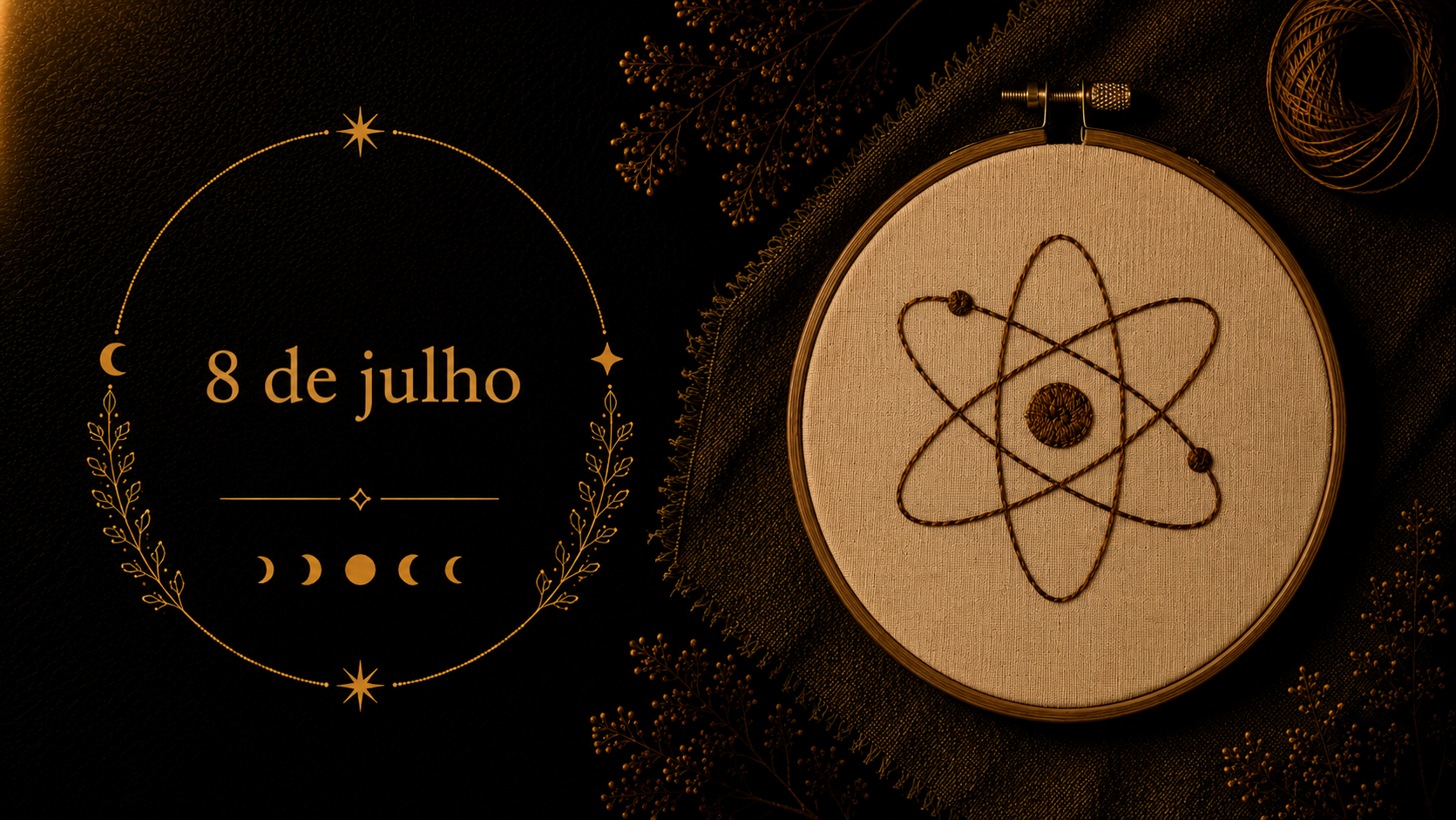
July 8 brings together two important celebrations: National Science Day and National Scientific Researcher Day. The date honors the founding of the Brazilian Society for the Progress of Science (SBPC), created on July 8, 1948, and considered one of the milestones in the organization of scientific research in Brazil.
The commemorations were officialized by two laws: one, from 2001, established National Science Day; another, from 2008, created National Scientific Researcher Day. More than celebrating institutions, the date reminds us of something essential: science exists because there are people dedicating years of their lives to asking questions.
Research almost always begins with a restlessness.
It is looking at something seemingly ordinary and asking: why?
It is distrusting ready made answers.
It is accepting that, often, good research produces more questions than answers.
Brazilian science is internationally recognized in several areas, and Information Science, Library Science, Archival Science, and Museology, my field of study, have a characteristic that has always caught my attention: the strong presence of women researchers.
Throughout my undergraduate studies, I had the privilege of learning from professors who helped build my way of thinking.
Prof. Dr. Márcia Regina da Silva (FFCLRP/USP) presented important pathways in altmetrics, expanding the way we understand the impact of scientific production beyond traditional metrics.
Prof. Dr. Deise Maria Antonio Sabbag (FFCLRP/USP) showed the beauty of knowledge organization, indexing, and documentary languages fundamental areas for those who believe that organizing information is also producing knowledge.
Prof. Dr. Ednéia Silva Santos Rocha (FFCLRP/USP) conducts research in scientific communication, bibliometric indicators, altmetrics, open access, and scientific integrity topics that now occupy a central place in the debate on science.
Prof. Dr. Silvia Maria do Espírito Santo (FFCLRP/USP), my advisor, was the one who helped me realize that memory and ancestry could also be legitimate paths of research. Her studies in Archival Science, Museology, and Information Science, combined with experience working with the Xavante and Kuikuro peoples, opened important doors for what I continue to develop today.
I also could not fail to mention two unavoidable references in Brazilian Archival Science.
Prof. Dr. Ana Maria de Almeida Camargo contributed decisively to the implementation of archival systems and to fundamental memory preservation projects, such as Brasil: Nunca Mais (Brazil: Never Again).
And Prof. Heloísa Liberalli Bellotto trained generations of archivists and researchers through works that remain required reading for those entering the field.
All of them, each in their own way, helped build the researcher who is now beginning to walk on her own.
Research has never been merely about producing articles. It is learning to observe the world carefully, to record what could be forgotten, and to recognize that knowledge is always built collectively. No research is born alone.
On this blog, scientific texts, essays, recipes, symbols, embroideries, and memories coexist. At first glance, they seem like different worlds but for me, they were all born from the same question that drives any researcher: “What can I learn from this?”
Today I can celebrate this date also as a researcher.
I still have much to study, much to write, and much to learn. But there is a quiet joy in realizing that the path begun in my undergraduate studies continues to be walked.
Research, after all, is exactly that.
A thread that someone started before us, which we hold for a while, and which, one day, we will pass on.
- LOPEZ, André Porto Ancona; CAMARGO, Ana Maria de Almeida. As razões e os sentidos: finalidades da produção documental e interpretação de conteúdos na organização arquivística de documentos imagéticos. 2001. (Suggested reading here)
- MARCUSSI, Elaine; DO ESPÍRITO SANTO, Sílvia Maria. Vila Tibério: um patrimônio da cidade em transformação. Documentação fotográfica e a Organização da Informação a partir do acervo do Jornal da Vila de Ribeirão Preto–a memória mensal de uma cidade. InCID: Revista de Ciência da Informação e Documentação, v. 2, n. 2, p. 189-207, 2011. (Suggested reading here)
- ROCHA, Ednéia Silva Santos. Contribuições da Fundação Ford à formação e consolidação de campos científicos no Brasil. 2016. (Suggested reading here)
- SABBAG, Deise Maria Antonio; DE OLIVEIRA SILVA, Bruna Daniele. Organização do conhecimento na era da cultura de convergência: as fanfictions e a curadoria classificatória. Revista Analisando em Ciência da Informação, v. 5, n. 2, p. 47-64, 2017. (Suggested reading here)
- SILVA, Márcia Regina da; HAYASHI, Carlos Roberto Massao; HAYASHI, Maria Cristina Piumbato Innocentini. Análise bibliométrica e cientométrica: desafios para especialistas que atuam no campo. InCID: revista de ciência da informação e documentação, v. 2, n. 1, p. 110-129, 2011. (Suggested reading here)
Leave a Reply