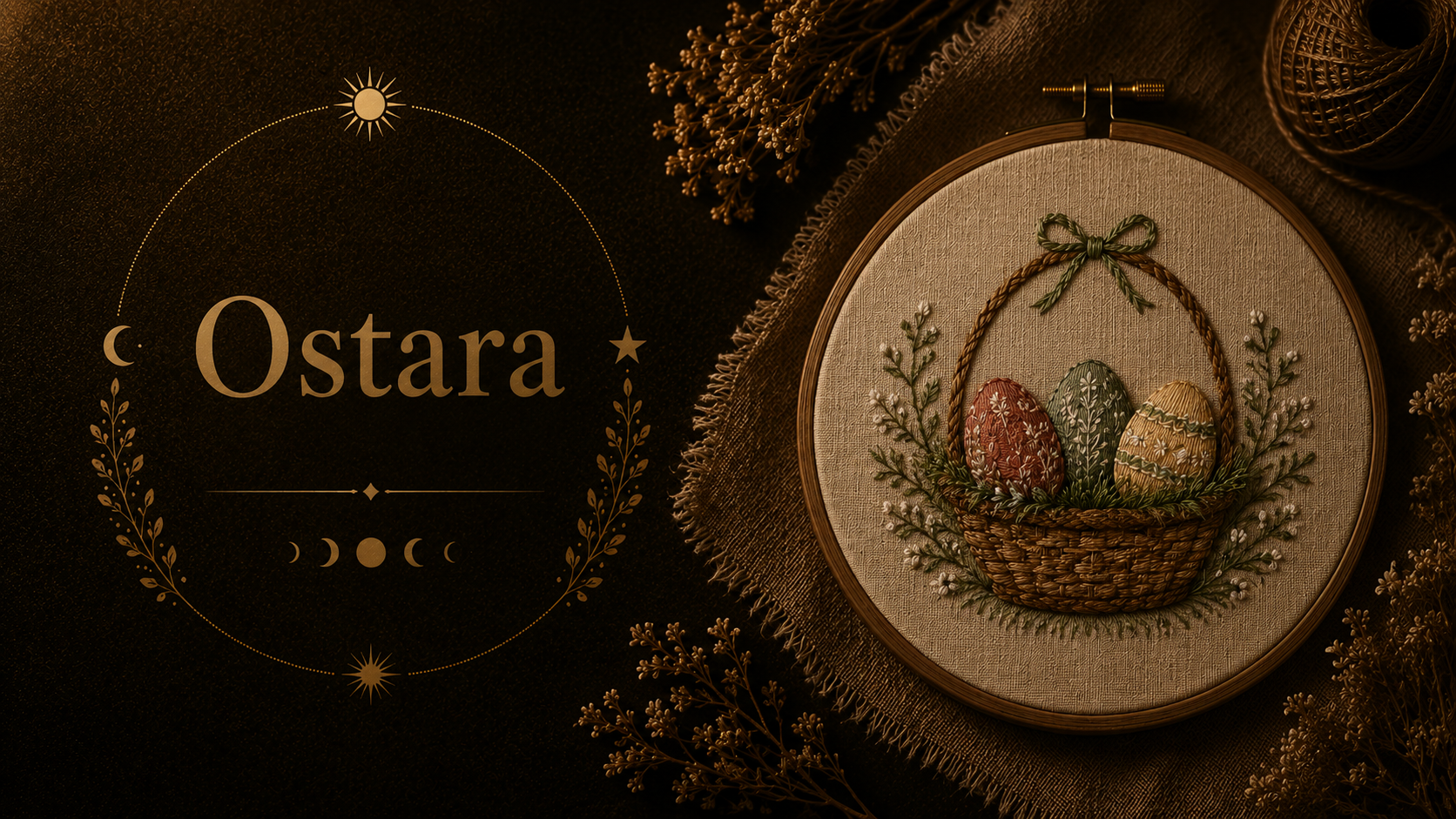
Spring, like autumn, is marked by an equinox. It is an astronomical phenomenon in which the Sun shines directly on the Equator, causing both hemispheres of the Earth to receive practically the same amount of light. The result is days and nights of very similar length.
Just as Mabon marks the autumn equinox and the moment of giving thanks for the harvest, Ostara celebrates the spring equinox. After the silence of winter, the earth awakens. Flowers bloom, days grow longer, and there seems to arise a spontaneous urge to open windows and let the air in.
Ostara is, in a way, the complement to Mabon. While autumn invites us to turn inward and let go, spring invites us to begin anew. It is the moment to observe what remained alive during winter and to allow new projects, ideas, and affections to find space to grow.
Ostara is a minor sabbat, celebrated in spring.
The name is often associated with the Germanic goddess Eostre (or Ostara), mentioned by the monk Bede in the 8th century as a deity related to spring and the dawn. Although there are few historical records of her worship, she has become an important figure in contemporary Neopagan traditions, symbolizing fertility, renewal, and new beginnings.
Various symbols traditionally linked to spring also appear in Easter celebrations across different cultures.
The egg represents life in potential that which is yet to be born.
The rabbit, known for its high reproductive capacity, has become a symbol of fertility and abundance.
Flowers announce the return of growth and the renewal of the landscape.
In English, the word Easter retains a possible connection to the name Eostre, although this association is still debated among historians. Regardless of its origin, many spring traditions ended up dialoguing and transforming over the centuries.
Ostara reminds us that winter is never permanent. The seed remained hidden for months, but it is still alive. When it finds light, water, and time, it breaks through the earth and begins again.
And in Brazil?
In the Southern Hemisphere, Ostara takes place around September 22 or 23, when spring begins.
But the Brazilian spring has its own personality.
It is the season of blooming ipê trees, the first jabuticabas, blackberries, rains that bring back the smell of wet earth, and the insistent song of cicadas. While the European spring celebrates the thaw after snow, ours explodes in colors and humidity, occupying gardens, sidewalks, and even the cracks in the asphalt.
The natural cycles continue to happen, they just express themselves in another way.
It is also during this time that many regions celebrate Cosme and Damião, a tradition that, in Brazil, gained its own characteristics by bringing together African, Catholic, and popular elements. For many people, spring also tastes like candies distributed to children.
That, in fact, is my strongest memory of the season.
I remember accompanying my mother to the market to buy bags of yogurt-flavored candies that would be distributed to the neighborhood children on Cosme and Damião day. There was a picture of the twins in the living room, and that movement of preparing the sweets was as much a part of the arrival of spring as the blooming ipê trees.
I confess that my glucose levels probably didn’t approve of so much candy. But since I survived, maybe it wasn’t that high after all.
And remember: among the Celts, the spring equinox was also known as Alban Eilir, an expression traditionally translated as “Light of the Earth.” The name celebrates the return of nature’s growth after winter and reminds us that every spring begins long before the first flowers appear.
- Cook, F. (2024). The wheel of the year: An illustrated guide to nature’s rhythms. Andrews McMeel Publishing. (Book suggestion here)
- Davies, A. (2023). The mystical year: Folklore, magic and nature. Quadrille Publishing. (Book suggestion here)
- Kiernan, C. (2019). A little bit of Wicca: An introduction to witchcraft. Sterling Ethos. (Book suggestion here)
- Mankey, J. (2025). Year of the witch: A planner and daybook for everyday magic. Llewellyn Publications. (Book suggestion here)
Leave a Reply