I have already spoken of the forest as a monument a landscape built over thousands of years by the hands of Indigenous peoples.
Today I want to look at it in another way, as mystery.
Because the forest also holds knowledge; it shelters remedies, food, stories, and paths that are not always written in books.
In traditions of Yoruba matrix, preserved and recreated in Brazil by religions such as Candomblé and Umbanda, two Orishas have a deep connection with this universe: Oxóssi and Ossaim.
Oxóssi is the hunter.
Not merely the hunter of animals, but the seeker the one who enters the forest knowing how to observe. His symbol is the ofá, the bow; and his arrow.
An ancient Itã (sacred story) tells that while other hunters wasted countless arrows, Oxóssi carried only one. And he hit his mark.
We live in a time when we are encouraged to do more and more study more, produce more, publish more. Oxóssi seems to remind us of the opposite: that a single well-aimed arrow is worth more than dozens shot without attention.
Ossaim, in turn, is the lord of the leaves.
From him comes one of the best-known proverbs of the Yoruba tradition: “Kó si ewé, kó sí Òrìsà” — “Without leaves, there is no Orisha.” The leaves carry healing, food, protection, and axé (vital energy). It is they that make possible much of the rituals and traditional care.
There is also a narrative according to which it was with Ossaim that Oxóssi learned the secrets of the forest. Here one seeks, and the other teaches; where one finds, the other preserves.
I have never been the person who fills the house with pots and manages to keep everything blooming, but curiously, I found another way of caring for plants.
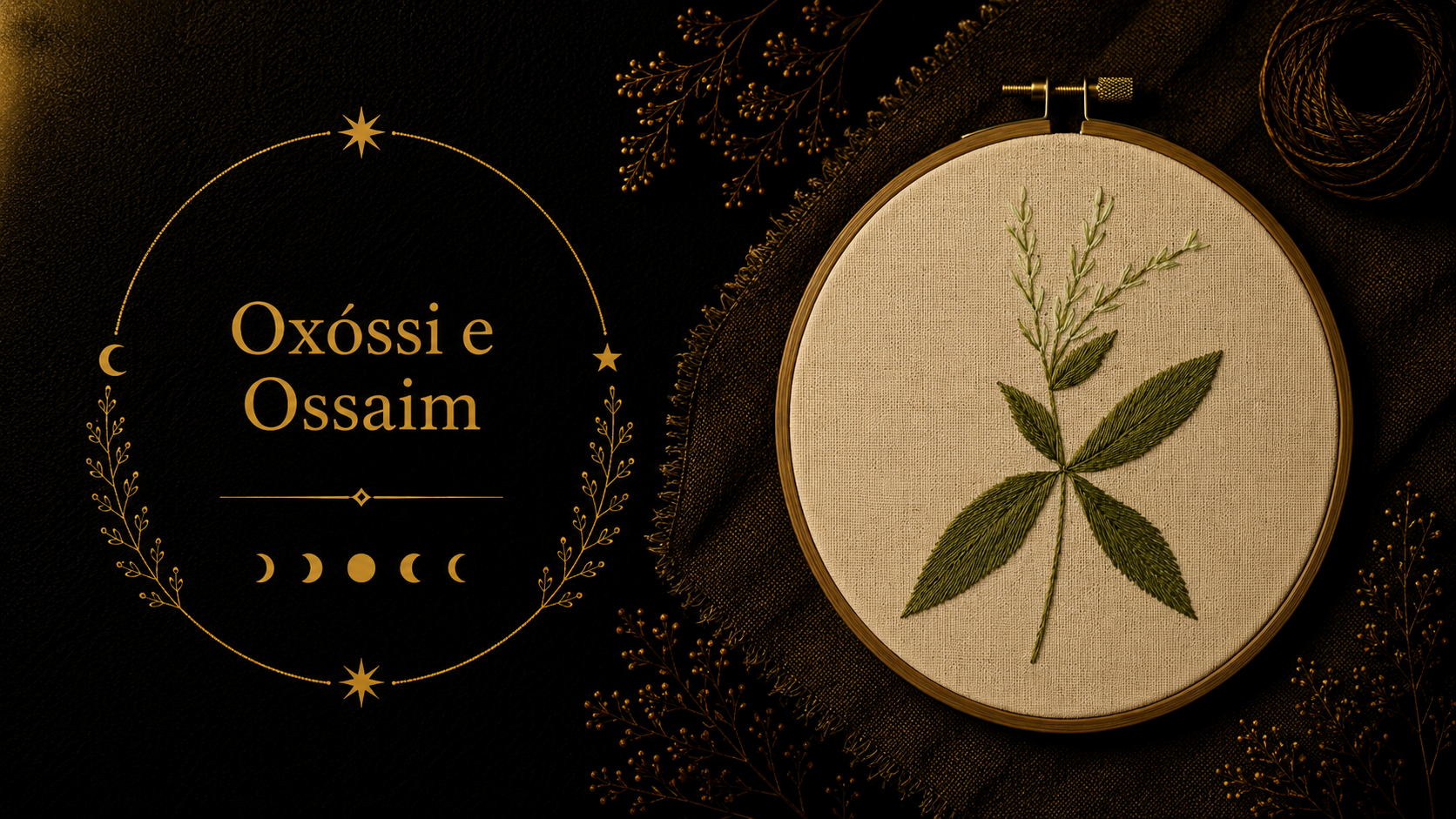
I embroider them. I do not cultivate the living plant, I cultivate its memory.
While an exsiccata inevitably loses part of its color over the years, embroidery preserves what my eyes found at that moment. The leaf remains green, the flower remains open, the thread fixes a memory that time, alone, would erase.
It is at this point that I feel my research approaching these symbols.
Oxóssi reminds me of the search and the research.
The curiosity to follow a trail until finding a question.
Ossaim reminds me of the responsibility of preserving what was found.
Transforming knowledge into memory.
In a time when so many forests are reduced to numbers, maps, or natural resources, embroidering a plant can also be a form of resistance.
It is saying that leaf is not merely a species.
It has history. It has beauty. It has memory.
For the construction of this space, I chose two plants: rue and rosemary. Not only because they are beautiful.
But because they carry centuries of symbolism linked to protection, care, and remembrance.
Perhaps that is what embroidery does. It transforms a needle into an arrow.
Not to cross the forest. But to reach memory before it disappears.
May Oxóssi inspire us to seek with attention.
And may Ossaim teach us to care for what we find.
- BARROS, José Flávio Pessoa de. A floresta sagrada de Ossaim: o segredo das folhas. Rio de Janeiro: Pallas, 2011. (Suggested reading here)
- SOUZA, João Marcos. OXÓSSI: O HERÓI DE UMA FLECHA SÓ. Revista Mosaico – Revista de História, Goiânia, Brazil, v. 13, p. 57–63, 2020. DOI: 10.18224/mos.v13i0.7553. (Suggested reading here)
Leave a Reply