You know when you start noticing the same symbol appearing in completely different stories?
That is exactly what happened to me while researching the Eye of Horus and Mati-Taperê, because both draw upon the image of the bird.
Horus, the Egyptian god of the skies, is represented as a falcon, or as a man with a falcon’s head. Mati-Taperê, a character from Amazonian tradition, takes the form of a nocturnal bird in many versions of the narrative. Depending on the region, she may be associated with the owl, the ghost bird, the Tapera naevia, or other birds that cross the night with their characteristic whistle.
Two distant cultures. Two myths with no known historical connection. And yet, the presence of the bird.
That is when I began to wonder: why this particular symbol?
One way of thinking about this recurrence appears in Carl Jung’s analytical psychology. For Jung, birds often represent images linked to the expansion of consciousness, shifts in perspective, and the ability to see beyond the immediate. This does not mean that all peoples attributed exactly this meaning to birds, but this reading offers an interesting key for observing how certain symbols keep reappearing across different human narratives.
I then began to look at these stories through this lens.
Mati-Taperê, when taking the form of a bird, does not represent merely a physical transformation. Her flight can symbolize a change in perspective. She returns different, bringing with her an experience that also alters those who cross her path.
With Horus, something similar happens.
After the battle against Seth, he loses one of his eyes. When Thoth restores it, Horus does not simply recover what he had lost. He continues his journey transformed by the very experience of loss. His vision is no longer the same. It has been rebuilt.
Perhaps that is precisely what flight represents in these stories: not just displacement, but a new way of seeing.
And then I came to Thoth. Curiously, he too is represented as a bird: the ibis.
Unlike the falcon, which is usually associated with the sky, the ibis walks along the flooded banks of the Nile. Before taking flight, it treads through the mud.
This image has always caught my attention.
Perhaps transcendence is not about abandoning matter, but about learning to walk through it. Before flight, there is the ground. Before height, there is the path.
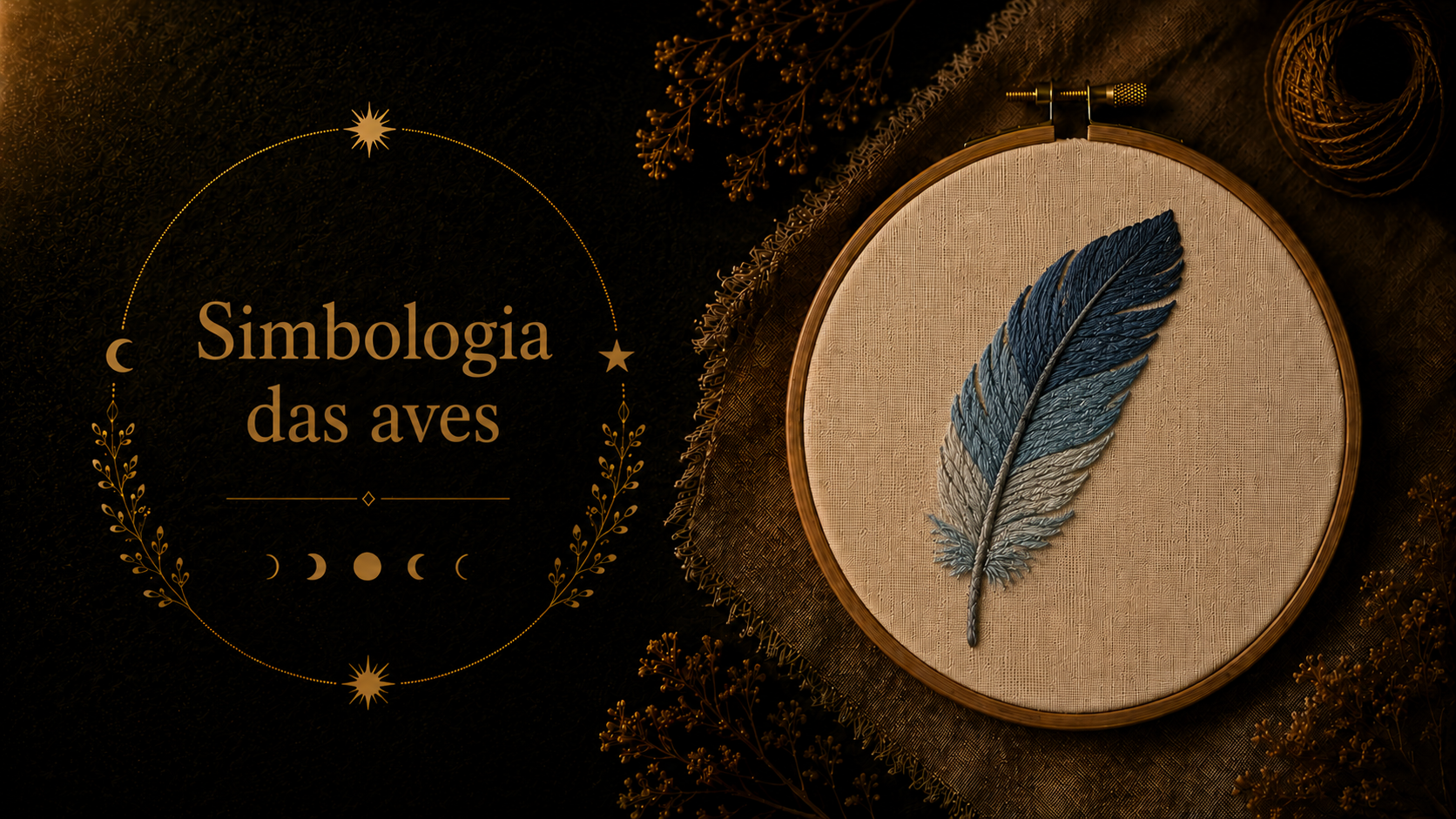
When I embroider a bird, I am not merely reproducing an animal. I am recording a gesture of transformation. The thread rises, descends, crosses the fabric, and returns. Like flight itself never completely straight, never completely still.
The bird reminds us that changing perspective is also part of the experience of living. Horus soars. Thoth writes. Mati-Taperê whistles.
Three different narratives. Three ways of thinking about transformation.
In the end, perhaps transformation does not happen only when we learn to fly. Perhaps it begins when we accept walking through the mud without ceasing to look at the horizon.
Leave a Reply