Some time ago, I began studying astrology as a tool for self-knowledge. I like astrology because it offers images for thinking about ourselves, much like myths, tarot, or literature do.
In addition to looking at a natal chart and studying the traditional planets and houses, many astrologers also use some asteroids in their readings. One of them is Pallas (or Pallas Athena), the second asteroid discovered in the Solar System, named after the Greek goddess of wisdom.
In mythology, Athena is born from Zeus’s head, already adult, fully armored and armed.
She is not a goddess linked only to knowledge, but to strategy, planning, and the ability to recognize patterns.
That is why, in the symbolic language of astrology, Pallas often represents how we organize ideas, solve problems, and perceive relationships that are not always evident.
While Mercury, for example, is often associated with communication and everyday learning, Pallas speaks of a more structural intelligence.
She asks how we think.
In my chart, Pallas is in Pisces, in the 4th House, and in retrograde motion.
Regardless of whether one believes in astrology or not, I found it curious to notice how this description dialogues with the way I construct thought and conduct my research.
Pisces is often associated with thinking through images, metaphors, and symbolic connections.
While a more analytical mind might look at a clock and try to take apart its gears to understand how it works, Pisces would look at the same clock and ask what time means.
Neither approach is better than the other, they are just different ways of understanding the world. And curiously, this is how I learn.
When I began to observe my own interests, I noticed a pattern that moves through mythology, embroidery, botany, tarot, memory, heritage, Information Science, technology, systems… and so on.
At first glance, these seem like very different themes, but when I approach them, they all ask exactly the same question: how do cultures preserve what they consider important?
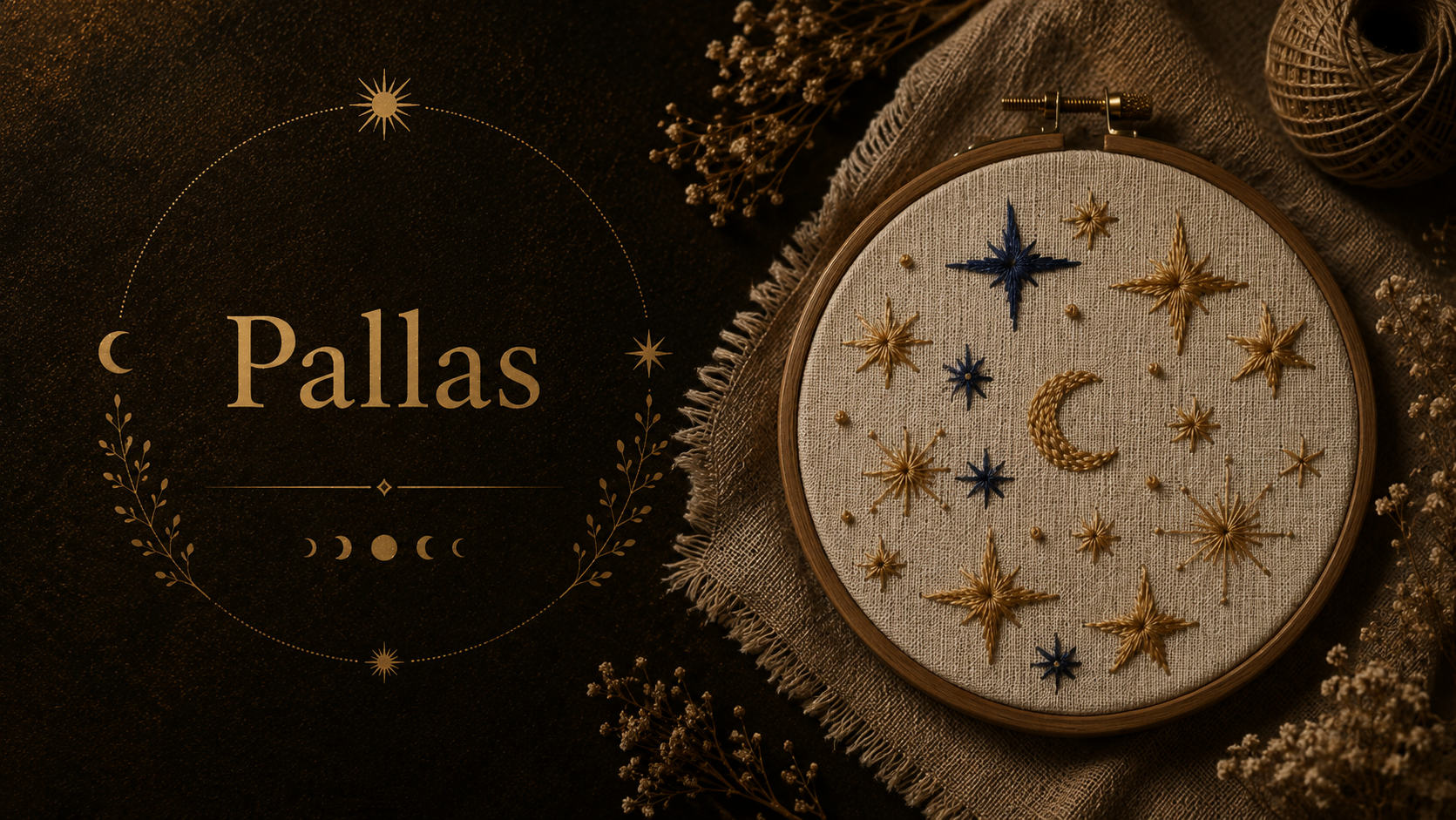
Perhaps that is why embroidery has become so central to my path because embroidery is not only the technique, but what it preserves.
I constructed a way of thinking and structured it through embroidery as a symbol. But I can also formulate thoughts through the symbolism of tarot, Amazonian myths, Itã in Umbanda. These are forms that directly converse with the influence of Pisces.
Continuing the analysis of my Pallas: besides the influence of Pisces, it is located in the 4th House; and in astrology, this is the house usually related to roots, ancestry, and memory. It is precisely about memory that I have been working in recent years.
And I continue researching heritage, documentation, material culture, and ways of preserving knowledge that crosses generations.
Not because astrology determined this path, but because I found it interesting to realize that it offers an image capable of describing it.
And to conclude this analysis, my Pallas appears retrograde. In astrological reading, this often indicates processes that mature first in the inner world, in intuition, and in thoughts.
I recognize this in my way of writing, as rarely does a text get born on the day it is published. Some remain weeks, and much more commonly months, being woven in silence.
The connections appear before the words; it’s only when I finally write that I have the impression of merely recording a drawing that was already ready some time ago.
In scientific research, something similar happens there are ideas that require years of observation before they find a form.
The text is only the last stage of a much larger process.
That is why I became so interested in what I discovered about my Pallas not for the promise of explaining who I am, but for the possibility of offering a metaphor to understand how I think.
In the end, it matters little whether it was the chart that described my way of looking at the world, or whether it was I who found in it an image capable of conversing with my experience.
Good metaphors do exactly that. They don’t answer questions. They help us formulate them better.
Author’s note: If you don’t like astrology but like astronomy, it’s worth exploring the interactive platforms NASA Eyes on Asteroids and Eyes on the Solar System, which allow you to follow in real time the position of thousands of bodies in the Solar System. Pallas belongs to the Main Asteroid Belt—that is, it is too distant to be visualized in these tools, because they focus on NEOs (Near-Earth Objects). But before becoming a symbol in astrology, Pallas is also a real celestial body, orbiting the Sun alongside thousands of others. And I am interested in both the science (astronomy) and the symbolic (astrology).
Leave a Reply