Have you ever noticed that some people feel there is a connection when they look at the moon?
This perception has accompanied humanity for thousands of years. In different cultures, the proximity between the average length of a lunation (about 29.5 days) and the menstrual cycle, which varies naturally from woman to woman and from one cycle to another, has inspired countless symbolic associations between the Moon, the female body, and the rhythms of life.
These relationships do not mean that the two cycles are the same, but they help explain why so many traditions have come to see in the Moon a mirror of human processes of transformation.
Remember when we began this conversation about cycles?
Today I want to return to it along a different path, and that path passes through Thoth.
I confess I am going through a phase of hyperfocus on this ancient Egyptian god of wisdom. But this time, it wasn’t mythology that led me to him.
It was the tarot.
Before writing this text, I drew a card and got the Moon. The card of cycles, of the unconscious, of that which grows and diminishes, appears and disappears. Then I drew a second card for guidance and got the Hermit. The lantern of time and record. It was at that moment that I noticed an association that had never occurred to me before.
Thoth is present in this story not because he represents a male god entering a female universe, but because from him comes the act of observing and recording.
According to an ancient Egyptian myth, the goddess Nut was prevented from giving birth on any of the 360 days of the year. To resolve this impasse, Thoth challenged the Moon to a game and won small portions of its light. With them, he created five additional days, known as epagomenal days, and it was during this time “outside the calendar” that Nut was finally able to give birth to Osiris, Isis, Set, Nephthys, and Horus the Elder.
Regardless of whether we believe in this account or not, I like the image it builds where Thoth does not create life, but he creates the space for life to happen.
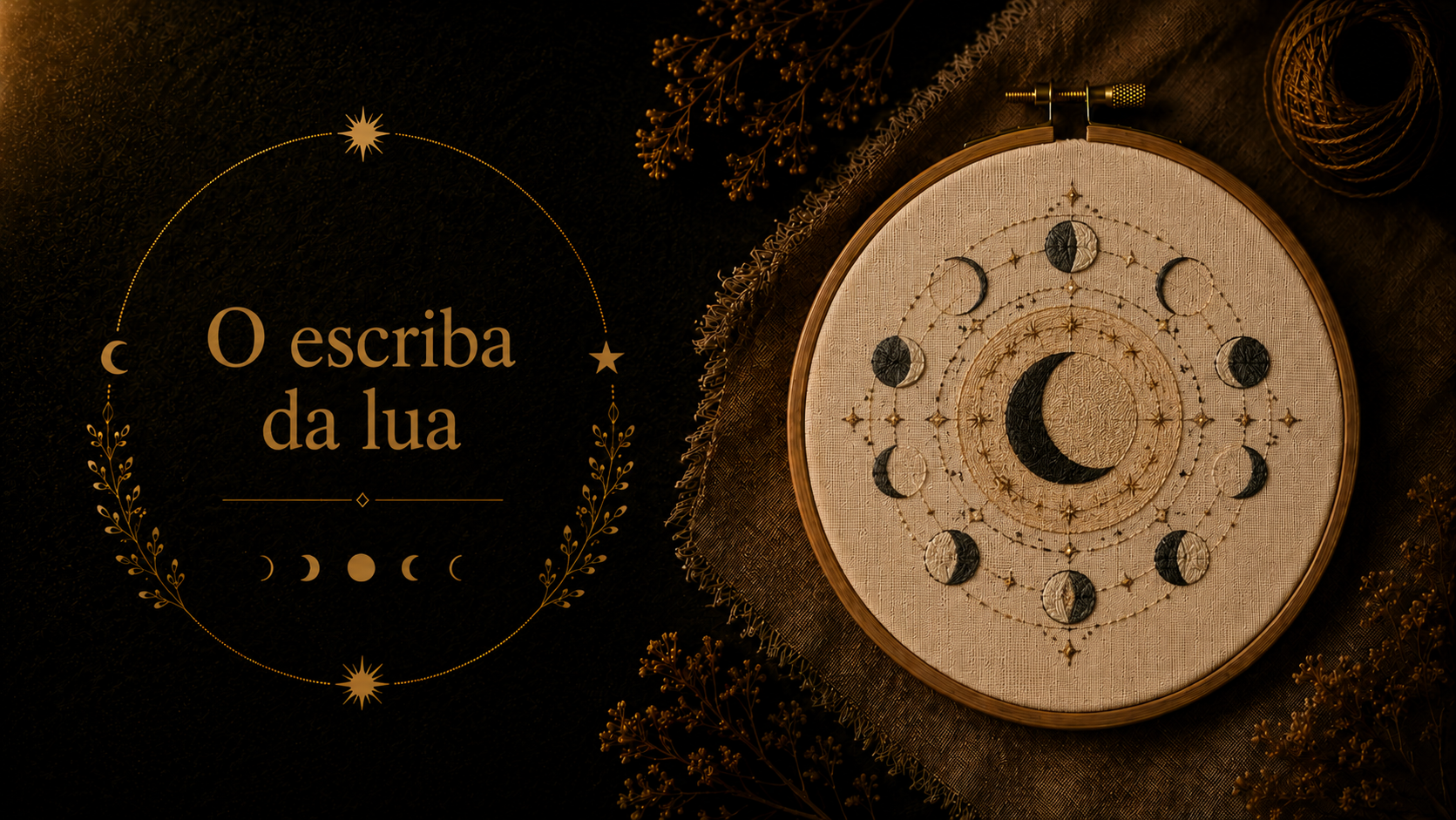
For those who like to track their own internal cycles, it is common to fill in a lunar mandala, which is, above all, an exercise in observation.
Over several months, we record emotions, energy, mood, menstruation, moon phases, or any other aspect we wish to follow. Little by little, what once seemed random begins to reveal patterns.
It is a silent task, almost the work of a scribe, and I think of Thoth as a symbolism of this process.
Not because he invented writing as we know it today, but because, in Egyptian tradition, he became the great patron of recorded knowledge, of the organized word, and of preserved memory.
Recording a cycle is doing something very similar transforming scattered experiences into knowledge about oneself.
It is taking the chaos of the days and organizing it into a narrative that can be understood. Deep down, embroidering also does this. Each stitch records an instant. Each color marks a phase. Each thread preserves a time that has already passed.
In Egyptian tradition, Thoth often appears associated with Ma’at, the goddess of truth, order, and balance. Knowledge without balance can turn into coldness. Order without observation can become rigidity. The two walk better together.
Recording a cycle does not prevent difficult days from existing. It also does not change the Moon’s course. But it changes the way we look at our own experience. What once seemed like mere confusion begins to reveal rhythm.
What seemed like chance begins to show recurrences. And, little by little, experience transforms into memory. Memory transforms into knowledge. Perhaps that is the silent work of every scribe.
And you?
What aspects of your life deserve to be recorded so that, one day, they too may reveal their own cycles?
- BELAUNDE, Luisa Elvira. El recuerdo de luna: género, sangre y memoria entre los pueblos amazónicos. Revista de Antropología, [S. l.], n. 8, mar. 2021. (Suggested reading here)
- PINCH, Geraldine. Egyptian Mythology: A Guide to the Gods, Goddesses, and Traditions of Ancient Egypt. Oxford: Oxford University Press, 2004. (Suggested book here)
- The RWS (Rider-Waite-Smith) tarot was used, created by Arthur Edward Waite in 1909 and illustrated by Pamela Colman Smith. Popularly known as the most commonly used deck for beginners.
Leave a Reply